

Goal Setting November 18, 2026
SMART Goals Examples for Work and Life (2026)
Real SMART goals examples for work, money, health, and home life, plus why a "correct" SMART goal can still be the wrong one. See 2026 templates.
Goal Setting 11 min read
30 short-term goals examples for career, health, money, and more, plus a simple filter to pick the ones that actually move you forward.
A short-term goal is anything you can finish in days, weeks, or a few months. Not years. Think “run a 5K by June” instead of “get in shape someday.”
The difference matters because vague goals don’t get done. “Run a 5K by June” is an action. “Get in shape” is a wish that evaporates by February.
Good short-term goals examples include finishing a certification in 30 days, paying off one credit card in 90 days, or landing three informational interviews this month. The list below is organized by timeframe and by life area, so you can jump to what you need.
Most lists like this dump 40 random ideas on you and call it a day. That’s not the real problem. The problem is picking which one actually matters to you. I built and exited a company. The short-term goals that moved the needle were never the ones that sounded good on a whiteboard. They were the ones tied to something bigger. That’s the filter this article uses, and it’s the one most goal-setting advice skips.
A short-term goal is a specific, time-bound target you can realistically complete between a single day and about a year. Most useful ones land somewhere between one week and 90 days. The shorter the window, the more concrete the goal needs to be.
“Read more” is not a short-term goal. “Finish one book by the end of the month” is.
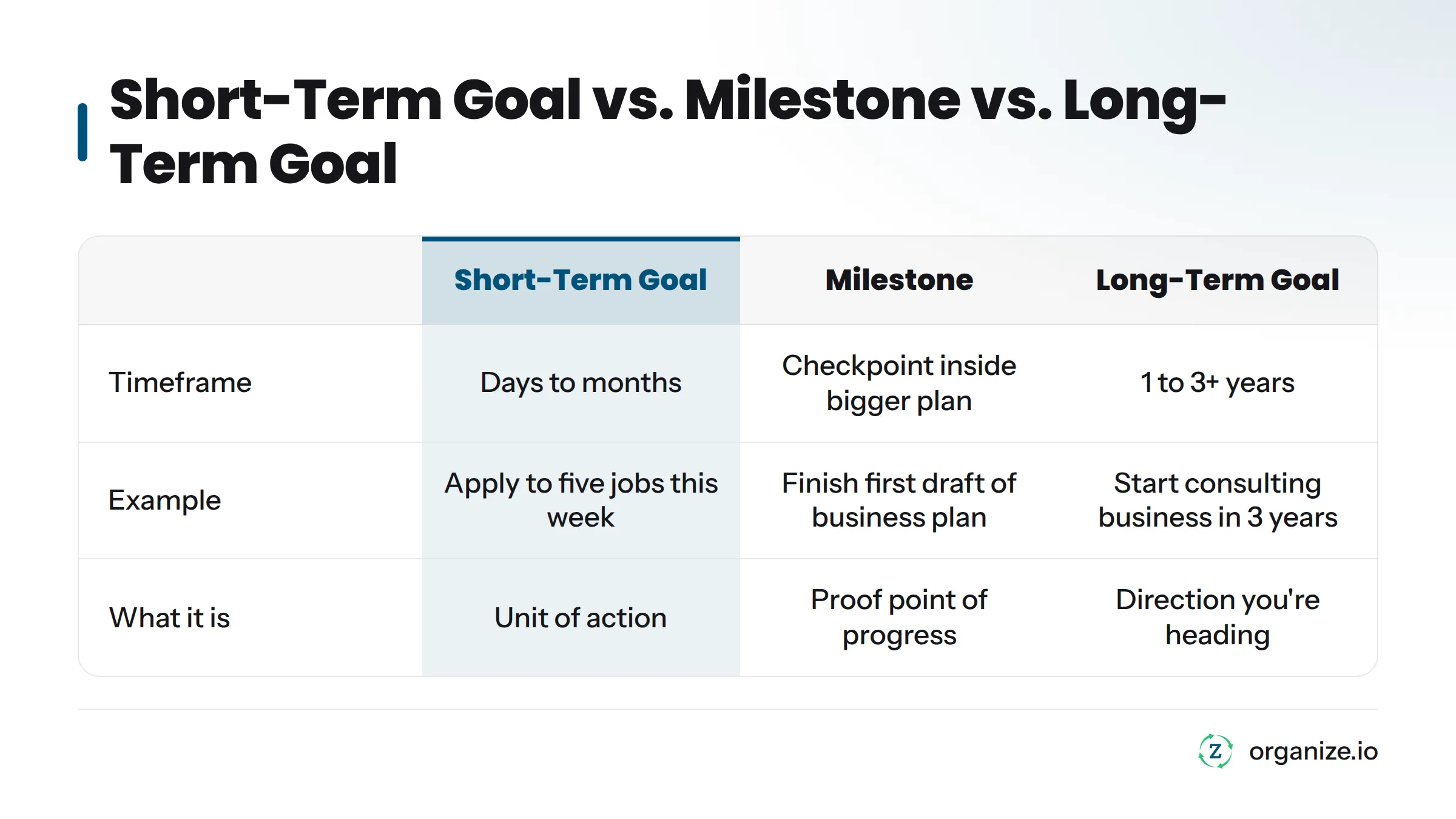
Here’s the distinction:
Short-term goals are the unit of action. Milestones are the proof points. Long-term goals are the direction. This page focuses on the short-term list you came here for. For the full breakdown of long-term goals, that’s covered elsewhere.
Here’s what almost nobody tells you: most short-term goals fail not because the person lacked discipline, but because the goal never connected to anything they actually cared about. You can hit every item on a to-do list and still feel stuck if none of it points toward a direction.
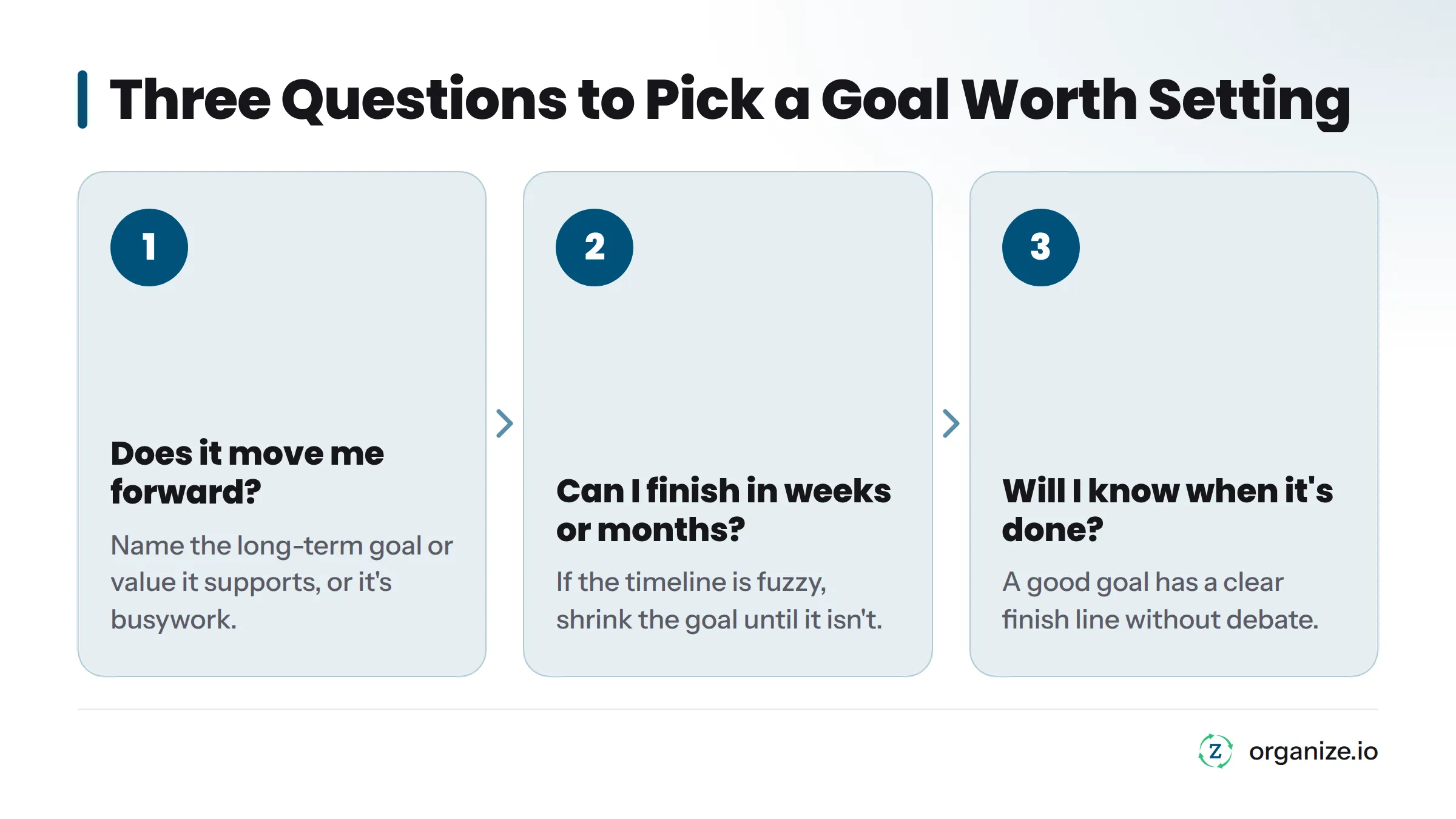
Before you pick a goal from the list below, run it through three questions:
When I was building my last company, we were drowning in features to build and ideas to chase. The short-term goal that mattered wasn’t “improve the product.” It was “get ten paying customers to use the new onboarding flow and tell us where they got stuck, within 30 days.” That goal was small enough to finish fast, but it pointed directly to the bigger direction: build a product people would actually pay to keep using. Every other short-term goal that quarter got measured against that filter. If it didn’t serve the bigger direction, it got cut, no matter how good it sounded.
Research on goal-setting by psychologists Edwin Locke and Gary Latham showed decades ago that specific, challenging goals produce better performance than vague ones like “do your best.” The reason is simple: specificity forces clarity, and clarity makes it obvious whether you’re on track.
If you want a structured way to turn direction into action instead of guessing, Zorga’s Compass feature exists for exactly this. It forces you to define the bigger direction first, so every short-term goal you set afterward has somewhere to point.
Pick one or two, not all ten.
Work goals need more precision because someone else is often judging whether you hit them. Vague goals read as weak. Specific ones read as competent.
Here’s how to turn one of these into a strong job interview answer: don’t just name the goal, name the direction it serves. “In the next 90 days, I want to get certified in project management because I’m aiming to move into a team lead role within two years” lands far better than “I want to grow.” That three-part structure - specific goal, specific timeframe, and the bigger thing it connects to - is also exactly what a good performance review self-assessment should use.
Money (short-term financial goals):
Health and fitness:
Personal, relationships, and learning:
For the full list of personal goals across every area of life, that’s covered in more depth on the personal goals page, including how to sequence them so they don’t compete with each other.
Students get a raw deal in most goal-setting content. Generic advice doesn’t account for semesters, applications, or GPA pressure. Here’s what actually fits a student’s calendar:
Picking a goal from this list is step one. What matters next is what you do with it.
A single short-term goal on its own is just a good intention with a deadline. Stack three or four of them with a clear direction behind them and you’ve got a real 90-day sprint instead of a scattered list.
The simplest way to keep a short-term goal alive past week one is a short, consistent check-in. A Weekly Review - even just 15 minutes every Sunday - where you ask “did I move this goal forward, and does it still matter” catches the goals that quietly died in week two before they waste another month of your attention.
| Short-Term Goal | Long-Term Goal | |
|---|---|---|
| Timeframe | Days to about a year | 1 to 10+ years |
| Example | “Pay off $2,000 in credit card debt in 90 days” | “Be debt-free and own a home in 5 years” |
| Purpose | Builds momentum, proves progress, keeps you honest | Sets the direction everything else points toward |
| How you measure it | Finished or not finished, usually a yes/no | Progress tracked across multiple milestones |
| Risk if done wrong | Feels busy but directionless | Feels inspiring but never gets worked toward |
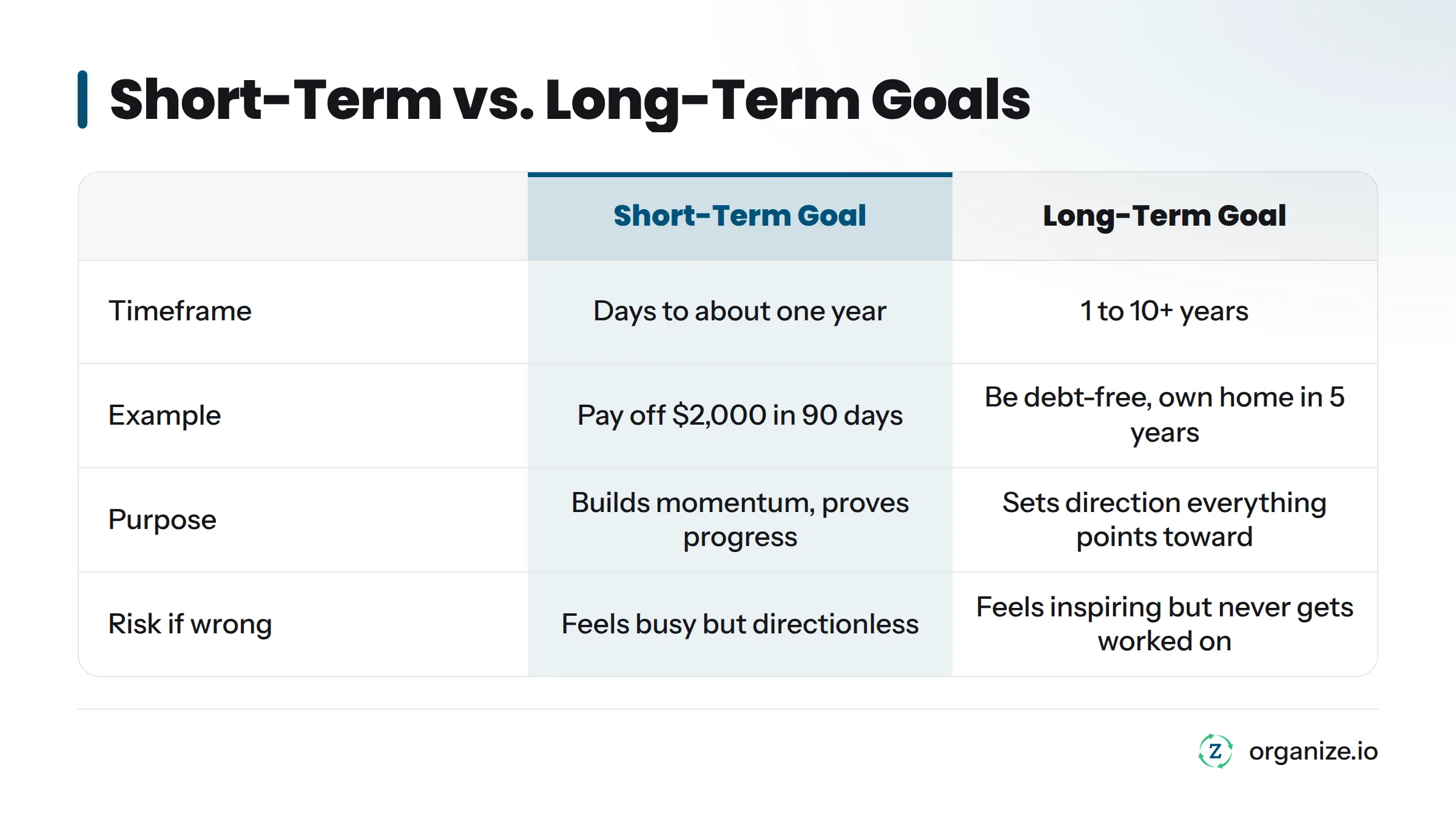
Short-term goals without a long-term goal behind them turn into busywork. Long-term goals without short-term goals underneath them stay fantasies. You need both, and the short-term ones only work if you can trace them back to the bigger one.
What are 10 short-term goals for students?
Raising one grade a letter level this term, finishing a scholarship application in two weeks, studying with active recall for 30 minutes daily for a month, meeting an advisor within two weeks, finishing one internship application this month, reading one assigned book ahead of schedule, attending every class for 30 days straight, organizing notes into one system within a week, finishing a resume draft in 10 days, and joining one club or study group within two weeks.
What are some good short-term life goals?
Good short-term life goals are specific, finishable within weeks or months, and tied to something bigger than themselves. Examples include building a $1,000 emergency fund in 60 days, running a 5K in 8 weeks, reconnecting with a family member this month, or finishing one overdue home project within 30 days. The common thread: each one has a clear finish line and a reason behind it.
What is the best answer for short-term goals in a job interview?
Name a specific goal, a specific timeframe, and the bigger career direction it supports. Example: “In the next 90 days, I want to get certified in data analysis because I’m working toward a move into analytics leadership.” Avoid vague answers like “grow professionally,” since interviewers are listening for specificity and self-awareness, not ambition alone.
What are some good short and long-term goals together?
A strong pairing looks like this: short-term goal, “close five new clients in the next 90 days,” paired with long-term goal, “build a $500,000 book of business within three years.” The short-term goal is the next provable step toward the long-term one, not a separate item on an unrelated list.
How many short-term goals should I set at once?
Most people do better with one to three active short-term goals at a time. More than that and attention splits so thin that none of them get real progress. If you’ve got a longer list of ideas, pick the two that most directly serve your current direction and park the rest.
Can a short-term goal become a long-term goal?
Yes. A short-term goal often reveals a bigger direction once you’ve completed it. Finishing one freelance project in 60 days might turn into a long-term goal of building a full freelance business. The short-term win is often the test that tells you whether the long-term goal is worth chasing at all.
You don’t need all thirty of these. You need one, maybe two, that actually connect to where you’re trying to go. Pick the goal, set the deadline, and write down the one bigger thing it’s supposed to prove. That’s the whole system: direction first, then the short-term goal, then the action.
If you want a structured way to run that system instead of keeping it in your head, Zorga’s free 5 Day Action Solution walks you through setting your direction with Compass and turning it into a Daily Action Plan you can actually follow. It’s built for people who’ve tried the apps and planners before and still feel stuck - not because they lack discipline, but because nobody showed them how to connect the small goal to the big one.
Related: 90 day sprint plan, SMART goals examples
Goal Setting November 18, 2026
Real SMART goals examples for work, money, health, and home life, plus why a "correct" SMART goal can still be the wrong one. See 2026 templates.
Goal Setting November 18, 2026
We tested the top vision board apps on goal-linking, follow-through, and pricing to find which one actually turns images into daily action in 2026.

Goal Setting November 10, 2026
Working harder isn't working. Learn the three hidden failure points—direction, action, feedback—that separate busy effort from real success.