

Goal Setting November 10, 2026
Productivity and Success: Why Busy Isn't Getting You Ahead
Working harder isn't working. Learn the three hidden failure points—direction, action, feedback—that separate busy effort from real success.
Goal Setting 11 min read
Real SMART goals examples for work, money, health, and home life—plus why a "correct" SMART goal can still be the wrong one. See 2026 templates.

A vague goal like “get healthier” won’t change your life. A specific one will: “Walk 30 minutes, 5 days a week, for 8 weeks.” The difference between wishing and doing is making your goal concrete enough to track and execute this week.
This guide covers SMART goals examples across work, personal finances, health, and learning. It also covers something most goal-setting content avoids: why a goal can pass every SMART checkpoint and still be the wrong goal for you.
SMART is shorthand for five filters your goal should pass: Specific, Measurable, Achievable, Relevant, and Time-bound. The term came from management thinking in the early 1980s, when leaders started replacing fuzzy objectives with goals you could actually check off. It’s not a certified standard or scientific law. It’s a useful checklist that tells you whether your goal has mechanics. It doesn’t tell you whether the goal matters.
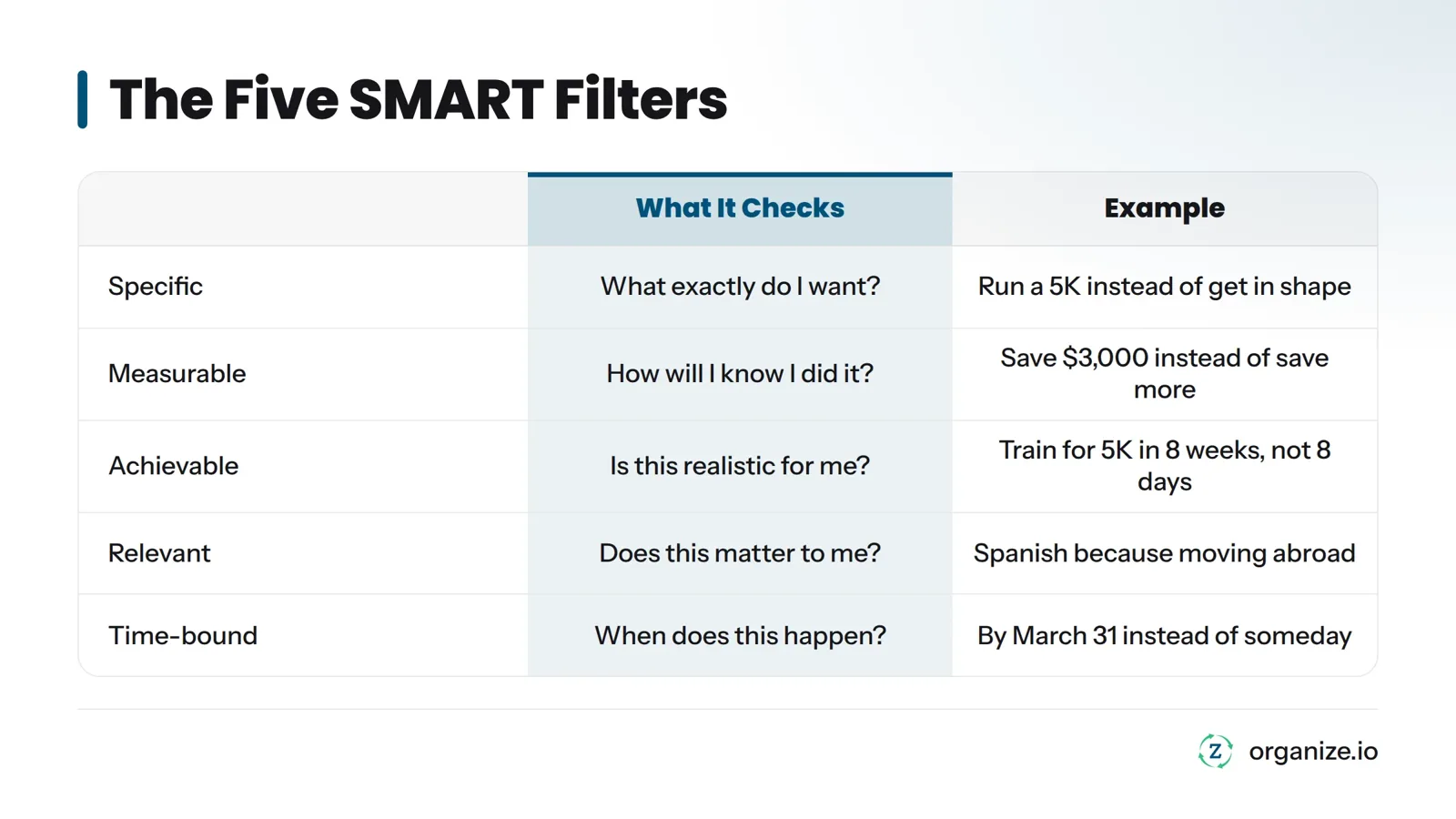
Here’s each filter, what it asks, and what it stops:
| Criteria | What It Checks | Example |
|---|---|---|
| Specific | What exactly do I want to accomplish? | “Run a 5K” instead of “get in shape” |
| Measurable | How will I know I did it? | “Save $3,000” instead of “save more money” |
| Achievable | Is this realistic with my time and resources? | Training for 5K in 8 weeks, not 8 days |
| Relevant | Does this connect to what matters to me? | Learning Spanish because you’re moving abroad |
| Time-bound | When does this need to happen? | “By March 31” instead of “someday” |
The shift from vague to SMART looks like this:
Vague: “I want to do better at work.”
SMART: “I will complete the PMP certification exam by June 30 so I can lead larger projects on my team.”
A SMART goal gives you a finish line. A vague goal gives you guilt.
For a deeper dive on building SMART goals into a weekly system, Zorga’s guide to time management and SMART goals walks through that integration.
Most people first encounter SMART goals during a performance review. These three examples go beyond the generic “work harder” statement.
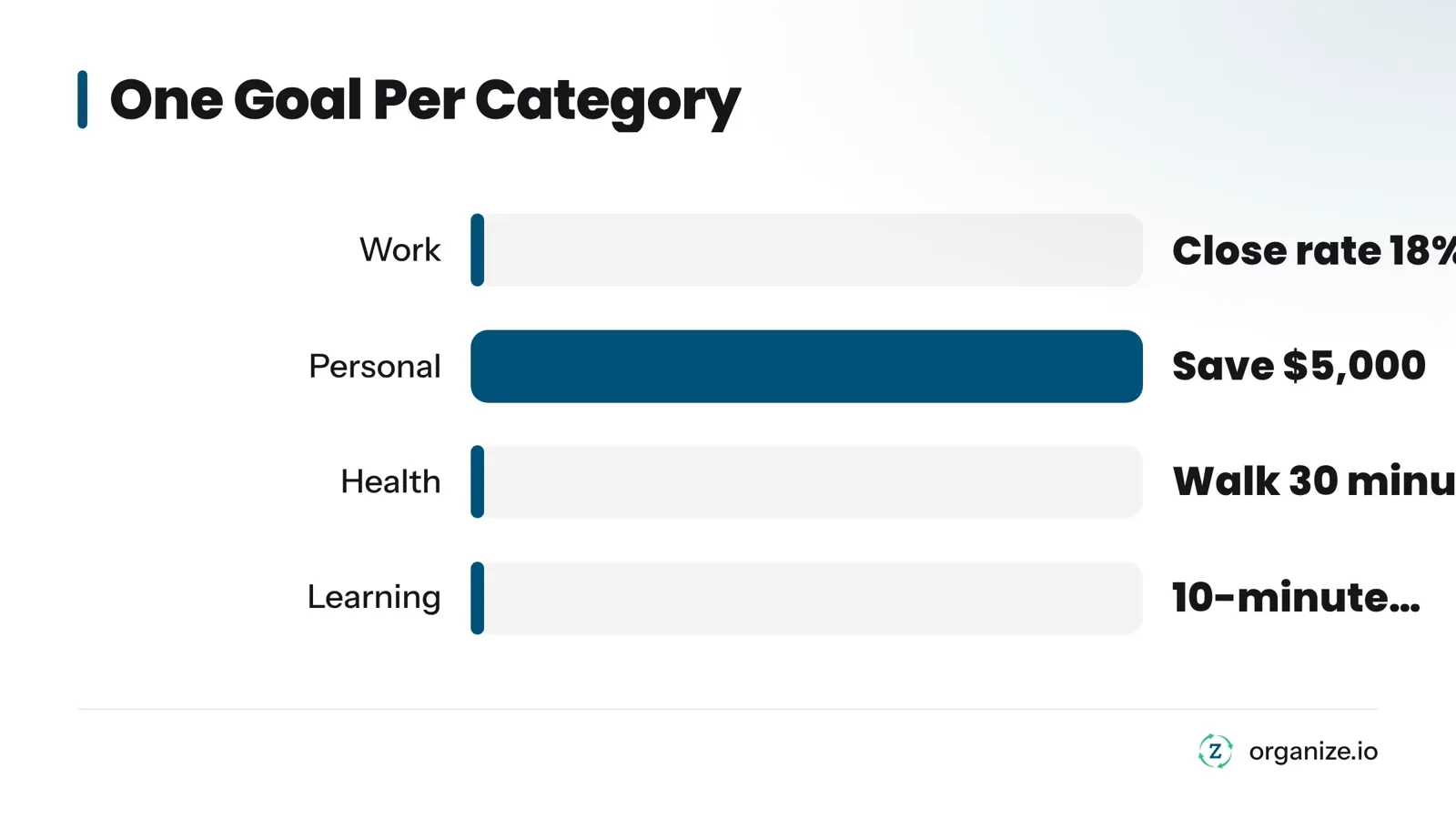
Goal: “I will increase my monthly sales close rate from 18% to 25% by end of Q2 by following up with every lead within 24 hours.”
Why this works: it names the exact number, the exact timeframe, and the exact behavior that will move it. No ambiguity.
Goal: “I will complete a public speaking course and lead three team meetings by December 1 to build my presentation skills before my next promotion review.”
Why this works: it connects a skill-building activity to a visible, countable output instead of leaving “get better at presenting” floating with no proof.
Goal: “I will launch the new onboarding guide for new hires by October 1, with sign-off from HR and my manager by September 20.”
Why this works: a buffer date (September 20) before the real deadline (October 1) builds in room to fix problems before they become late deliverables.
If performance goals are part of your formal review cycle, Zorga’s performance review self-assessment examples help you translate these into the language your manager expects. Once you’ve written the goal, the next step is the plan. Zorga’s guide to building an action plan covers that exactly.
Work goals get all the attention. Personal life goals need the same rigor. Here are three that matter: money, relationships, and home.
Goal: “I will save $5,000 for an emergency fund by December 31 by automatically transferring $420 from each paycheck.”
Why this works: the per-paycheck number makes this self-executing. You’re not relying on willpower every month; the transfer already happened.
Goal: “I will have one phone-free dinner with my family every weeknight for the next 30 days.”
Why this works: it’s small enough to actually do every day, which matters more than an ambitious goal you quit in week two.
Goal: “I will declutter and organize one room in my house each week for 6 weeks, starting with the garage.”
Why this works: breaking a big, dreaded project into weekly units removes the excuse that there’s “no time” to start.
For more examples broken into weekly steps, Zorga’s weekly goals examples guide shows how to structure goals like this into a repeatable weekly rhythm.
Health goals fail more often than any other category, mostly because people set goals based on what they think they should want, not what they’ll actually do. These two examples stay grounded.
Goal: “I will walk 30 minutes, 5 days a week, for the next 8 weeks.”
Why this works: it picks the easiest form of exercise to sustain and gives it a real but short window to prove out before you add anything harder.
Goal: “I will be in bed with lights off by 10:30 PM on weeknights for the next 21 days.”
Why this works: it targets the single highest-leverage health habit with a deadline short enough to actually stick to.
Learning goals are easy to state and hard to finish because “learn Spanish” has no finish line. These examples fix that.
Goal: “I will complete 100 lessons in a language app and hold a 10-minute conversation in Spanish by June 1.”
Why this works: the conversation test matters more than the lesson count. It proves you can use the skill, not just that you logged app time.
Goal: “I will finish 12 books related to my field by December 31, reading at least one per month.”
Why this works: monthly pacing turns a big annual number into something you check far more often, which keeps you honest.
Here’s what nobody selling you on SMART goals wants to say: a goal can pass every SMART filter and still be a goal you shouldn’t chase.
SMART checks mechanics. It doesn’t check meaning. You can write a perfectly formed SMART goal to get a promotion you don’t want, save for a house in a city you’re not sure about, or train for a marathon because your coworker is doing one. Every box gets checked. The goal still isn’t yours.
I’ve watched this play out with people who built entire systems around a goal, hit every milestone, and felt nothing at the finish line. The execution was fine. The problem was that nobody asked, before the first milestone, whether this goal connected to something that mattered.
This gap is why Zorga built the Compass. It sits above your goals, not below them. It forces the “why” question before you ever get to the “how.” A SMART goal without a Compass behind it is a well-built ladder leaning against the wrong wall.
A goal can pass every SMART test and still be a goal you shouldn’t chase.
Don’t skip SMART. Just don’t stop there. Before you finalize any goal, ask the one question SMART never asks: does this connect to a direction I actually care about, or does it just sound responsible? Zorga’s guide to direction-first goal setting walks through how to work through that question step by step.
None of these examples are meant to be copied as-is. They’re templates. Here’s how to adapt one in under five minutes:
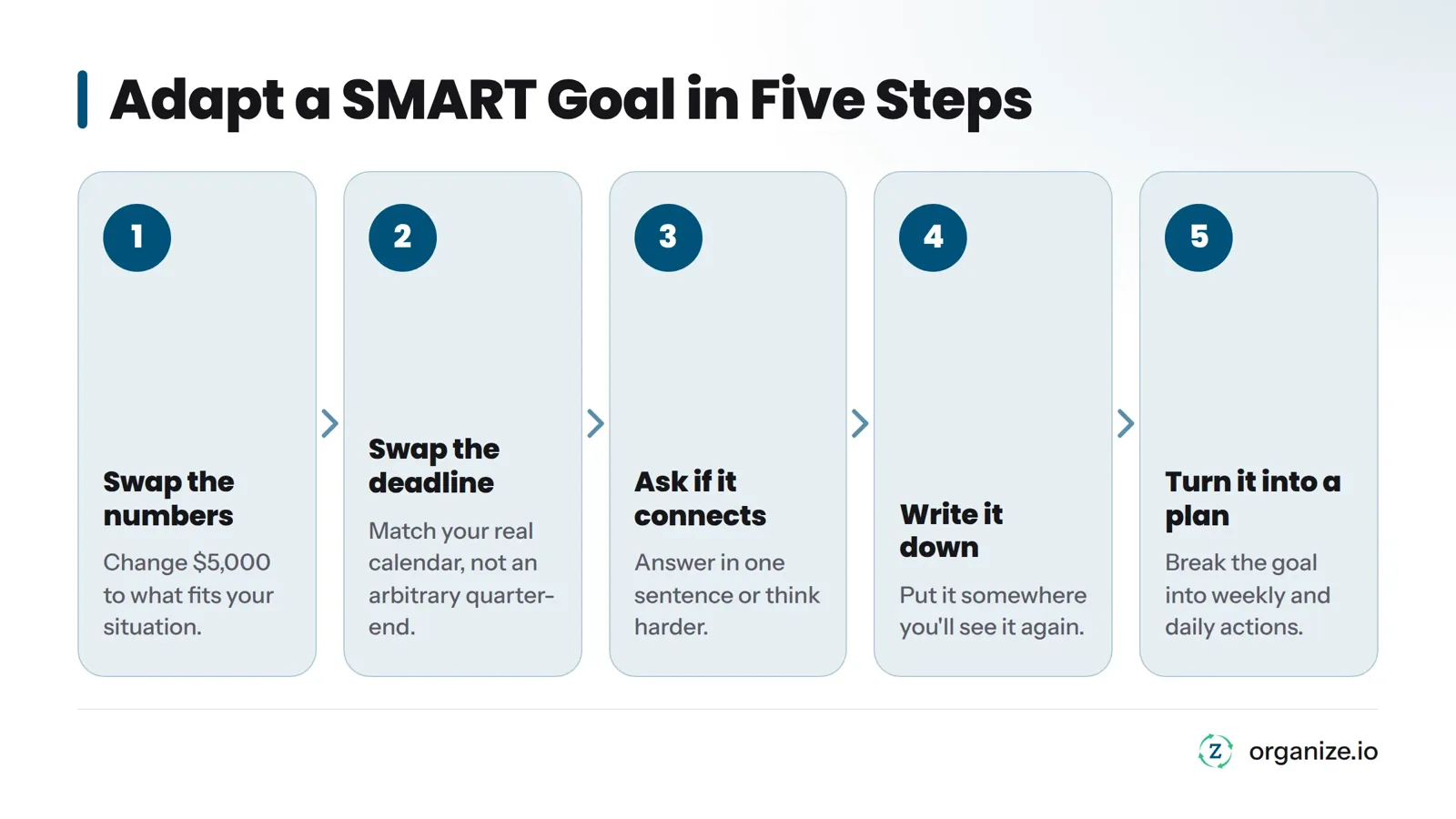
For that last step, Zorga’s guide to building an action plan breaks a goal into the weekly and daily actions that move it forward. For longer goals, Zorga’s guide to setting life goals and its guide to personal goals are good next stops. If you’re still working out what to set a goal about, how to set goals for yourself covers that groundwork.
What are the 5 SMART goals for work examples?
A solid set covers different angles: a sales or output metric (raise close rate from 18% to 25% by Q2), a skill goal (finish a course and lead three meetings by December), a project deadline (launch a deliverable with a buffer date), a communication goal (send a weekly status update every Friday for 8 weeks), and a professional development goal (earn a certification by a specific date).
Can you give an example of a SMART aim?
“I will walk 30 minutes, 5 days a week, for the next 8 weeks.” It names the activity, the amount, the frequency, and the deadline, which covers all five SMART criteria in one sentence.
What are three good goals for work?
Improve a specific performance metric by a set percentage within a quarter. Build one new skill tied to a career outcome within 90 days. Ship one overdue project with a hard deadline and a buffer date before it.
How do you write your own SMART goals?
Start with the outcome you want, then run it through the five filters in order: make it specific (name the exact result), make it measurable (attach a number), make it achievable (check it against your real time and resources), make it relevant (connect it to something you care about), and give it a deadline. Write the final version as one sentence.
What’s a simple SMART goal example for beginners?
“I will read for 15 minutes before bed, 5 nights a week, for the next 30 days.” It’s small, countable, and doesn’t require buying anything or changing your whole schedule.
Why do some SMART goals fail even when they meet all five criteria?
Because SMART checks the structure of a goal, not whether the goal matters to you. A goal can be perfectly specific, measurable, achievable, and time-bound on paper and still fail if it was never connected to something you genuinely want. That’s a direction problem, not a SMART problem. Rewriting the goal statement won’t fix it.
A good SMART goal gives you a template. It doesn’t give you a reason to care. That part is on you.
If you want a system that starts with that question instead of skipping it, Zorga’s Compass feature sets your direction first, then helps you build the SMART goals, weekly actions, and daily plans that actually serve it. You can also browse Zorga’s goal-tracking tools to see what fits your workflow, or head to the Zorga homepage to see the full system in action.
Goal Setting November 10, 2026
Working harder isn't working. Learn the three hidden failure points—direction, action, feedback—that separate busy effort from real success.

Goal Setting November 7, 2026
Stop reacting to your inbox. Learn the 3-step method to set direction, pick one priority, and protect a focus block that actually moves goals forward.
Goal Setting November 1, 2026
Willpower runs out, but systems don't. Learn the 4-pillar framework behind productivity tips that hold up under real pressure, not just in January.