

Goal Setting November 7, 2026
Focused Productivity: How to Work With Real Focus
Stop reacting to your inbox. Learn the 3-step method to set direction, pick one priority, and protect a focus block that actually moves goals forward.
Goal Setting 9 min read
Working harder isn't working. Learn the three hidden failure points—direction, action, feedback—that separate busy effort from real success.

Being productive doesn’t guarantee success. You can check off every task, clear your inbox, and finish the quarter exactly where you started. That gap exists because productivity measures effort - how much you do. Success measures whether that effort actually mattered.
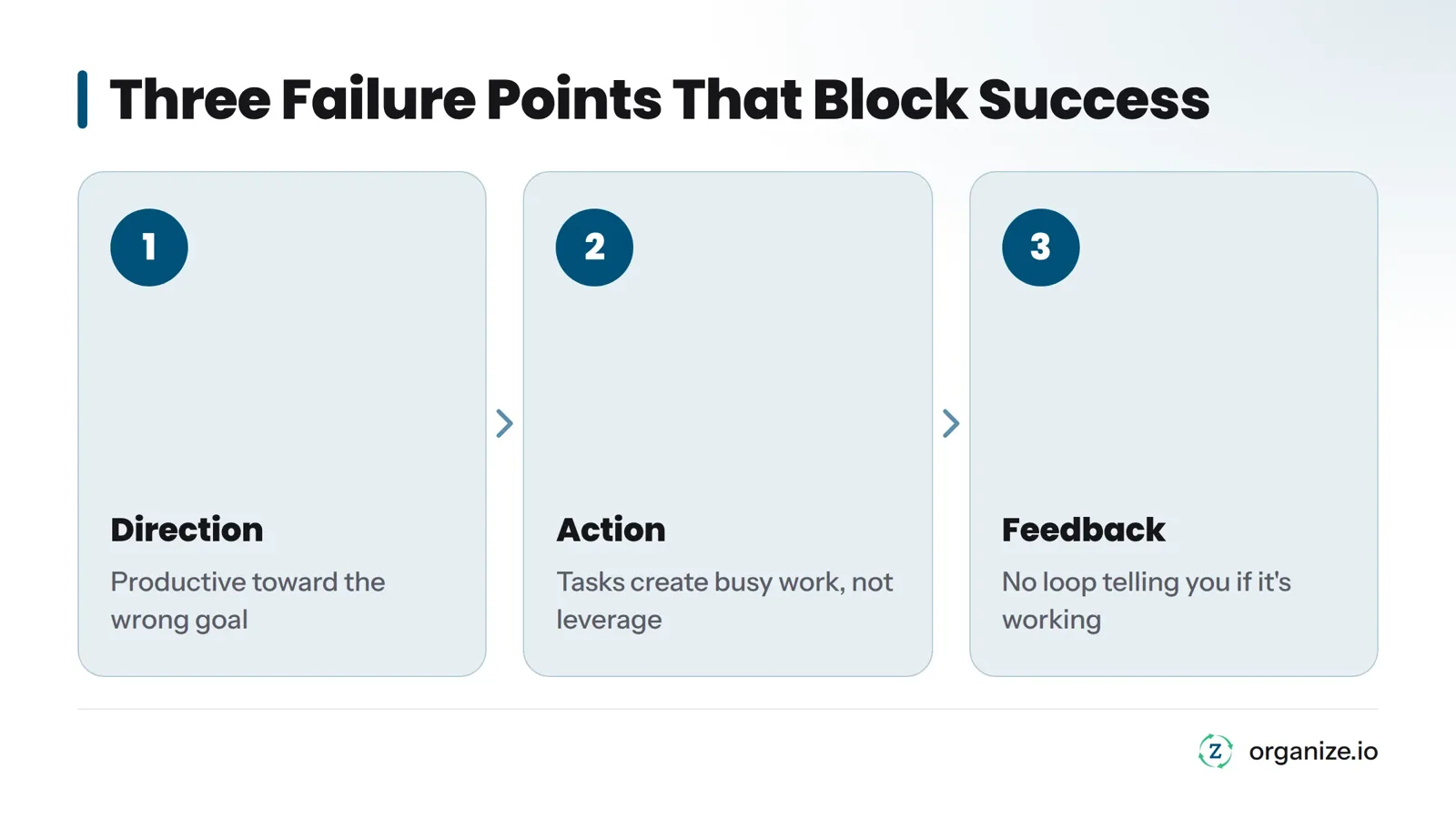
The separation comes down to three things: direction, action, and feedback. Miss any one of them, and you can work flat-out for years without getting anywhere.
I’ve run a company that made the INC5000 list. I’ve also spent entire years working harder than I’d ever worked before while the business barely moved. Both things were true at once. The contradiction is worth understanding.
Productivity tells you how much you got done. Success tells you whether what you got done actually moved something you care about. Those are two different scoreboards.
Busyness feels like progress because it’s visible. A full calendar, a cleared inbox, a long to-do list checked off - that produces a sense of motion. But motion isn’t the same as getting somewhere. A treadmill gives you motion too.
This isn’t about motivation or discipline. It comes down to three specific failure points that show up again and again:
Any one of these three can quietly cancel out months of effort. Most people who feel stuck have at least one broken, often without knowing it.
A few years into running my company, I hit a point where I was working more than I ever had. Fourteen-hour days were normal. My calendar ran from the first meeting to the last email. I felt like the hardest-working person in the building because I was.
The business wasn’t moving.
Revenue was flat. The team was busy but not shipping anything that moved our numbers. I kept adding hours, more meetings, more initiatives, assuming the problem was that I hadn’t pushed hard enough yet. I was wrong. The problem wasn’t effort. It was that I had never actually stopped to check whether the hundred small things I was doing added up to the handful of things that mattered.
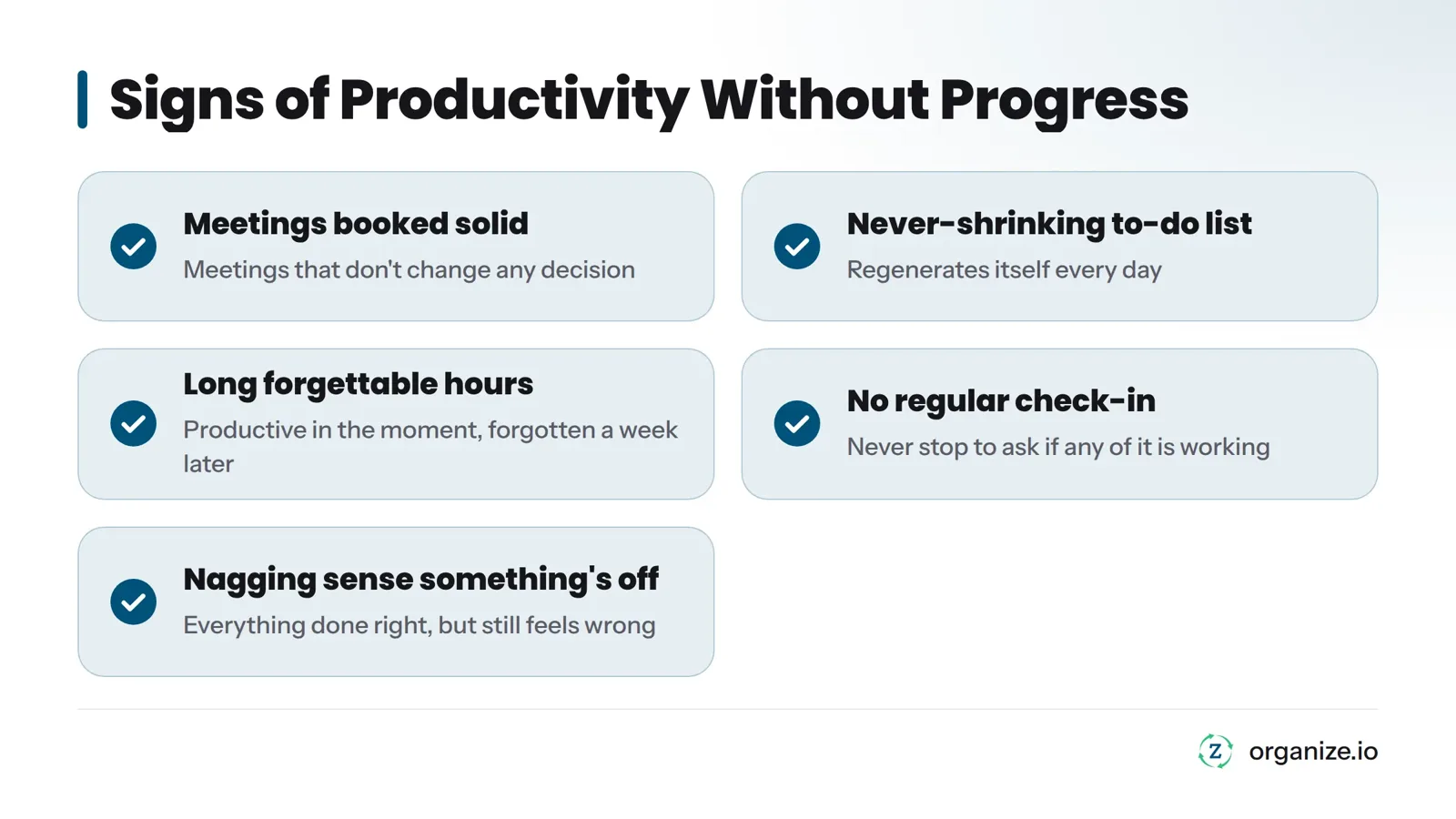
What that looked like:
That last one is the giveaway. If you feel like you’re doing everything right but something still feels off, that’s not imposter syndrome. It’s usually a real signal that one of the three failure points is broken.
Once I stopped assuming the fix was “more hours,” I started looking at where the effort was actually breaking down. It came down to three categories, and every unproductive stretch of my career traces back to one or more of them.
Think of it as a simple decision tree. If you’re productive but not succeeding, follow it down one of three branches:
Direction failure means you’re putting in real effort, but it’s aimed at a goal that doesn’t matter to you, or doesn’t connect to the outcome you say you want.
Here’s a concrete example. A sales rep spends weeks perfecting a pitch deck with better slides, better animations, better copy, while their actual numbers depend on making more calls. The deck work is real effort. It’s also aimed at the wrong target. No amount of extra polish on the deck fixes a call-volume problem.
Direction failure is sneaky because the work itself can be high quality. The issue isn’t the execution. It’s that the execution is pointed at the wrong goal entirely. More effort in the wrong direction just gets you further from where you wanted to be, faster.
Action failure means the goal is right, but the tasks you’re doing don’t actually move it. This is the gap between output (how much you produced) and outcomes (what actually changed because of it).
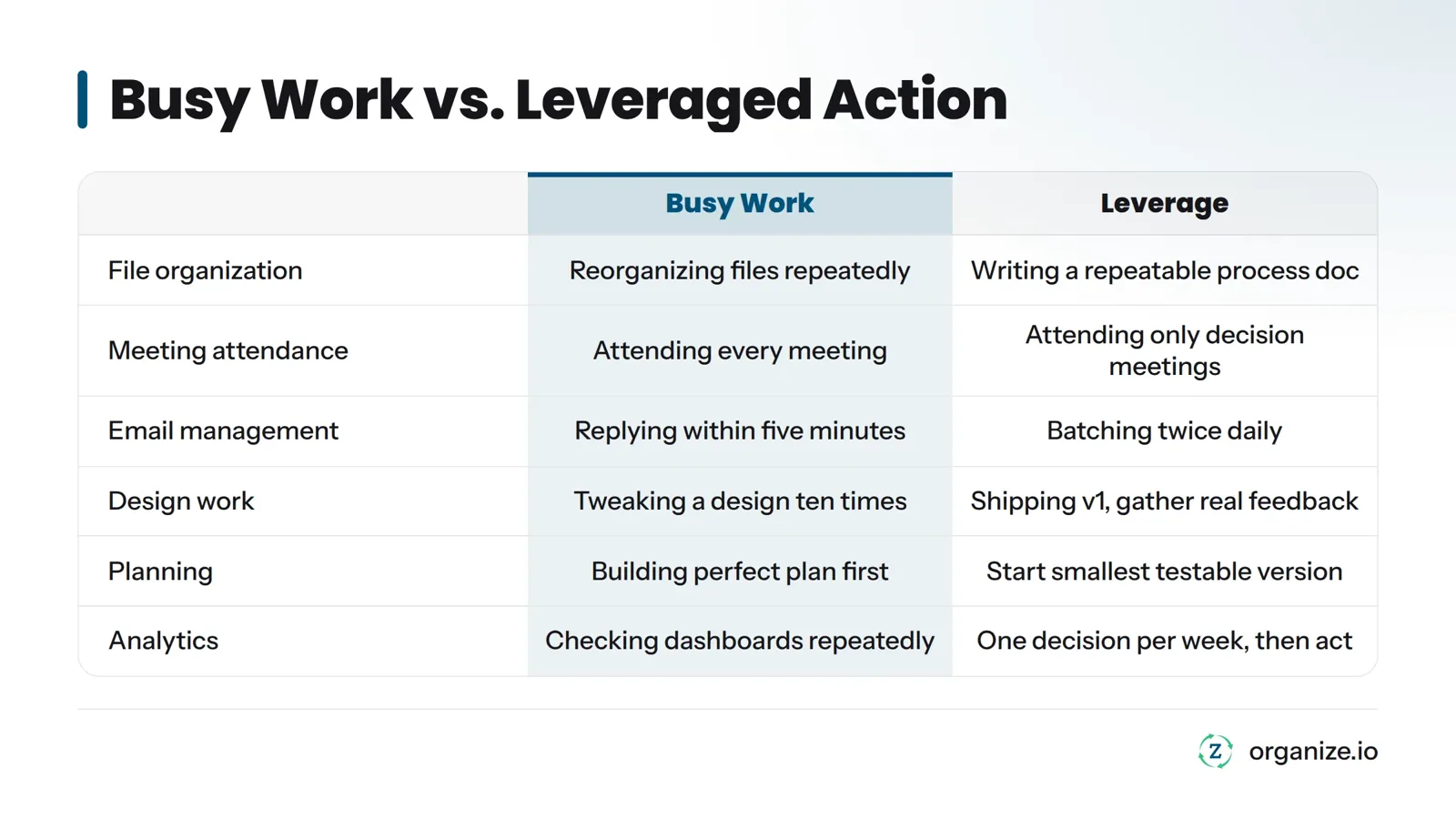
Leverage is the test. A leveraged action is one where a small amount of your time produces a result that keeps paying off, or that unblocks something bigger. Busy work consumes your time and produces a result that evaporates immediately, with nothing compounding from it.
| Busy Work | Leverage |
|---|---|
| Reorganizing files for the third time this month | Writing a repeatable process doc the whole team can use |
| Attending every meeting to stay in the loop | Attending only meetings where you make a decision |
| Replying to every email within five minutes | Batching email twice a day and protecting deep work blocks |
| Tweaking a design for the tenth time | Shipping version one and gathering real feedback |
| Building a perfect plan before starting | Starting the smallest testable version of the plan |
| Checking analytics dashboards repeatedly | Making one decision based on last week’s numbers, then acting |
Notice the pattern: busy work often feels responsible and careful. That’s exactly why it’s easy to mistake for progress. Leverage usually feels a little uncomfortable because it means shipping something before it’s perfect or saying no to something that looks urgent.
If your days are packed but your weeks look the same as each other, that’s usually an action problem.
Feedback failure means you have no regular mechanism that tells you whether your direction and actions are actually producing results. Without that loop, a direction problem or an action problem can run for months, even years, completely undetected.
This is where vanity metrics do real damage. Vanity metrics are numbers that go up and feel good - follower counts, hours logged, tasks completed, meetings attended - without connecting to whether the thing you actually care about is improving. A feedback loop built around vanity metrics tells you “everything’s fine” right up until it isn’t.
A real feedback loop asks a harder question on a fixed schedule: did this week’s effort move the number that actually matters? Gallup’s State of the Global Workplace research found that regular, structured check-ins on progress - not just activity - are strongly linked to higher engagement and performance.
Without a feedback loop, course correction never happens because there’s nothing prompting it. You just keep doing the next task on the list.
Answer these questions honestly, in order:
Find your starting point:
Once I started setting direction before touching a task list, the daily grind didn’t get easier. I didn’t suddenly have more hours. What changed was that the hours I had stopped getting absorbed by work that didn’t matter.
I started every week by writing down the two or three outcomes that actually defined success for that week, before I let a single task onto the calendar. Then every task had to justify its place against that short list. Most of what used to fill my days didn’t make the cut, and dropping it didn’t cost me anything because it was never moving the business in the first place.
The shift was obvious within weeks: fewer meetings, shorter to-do lists, and a much clearer sense of whether a given day had actually counted for something.
That’s direction-first planning. Goals and vision come first. Tasks get built around them, not the other way around.
Is productivity the key to success?
No. Productivity is a multiplier, not a cause. It multiplies whatever direction you’re already pointed in. Point it at the wrong goal, and high productivity just gets you there faster.
Can you be productive but not successful?
Yes. You can complete a high volume of tasks, hit every item on a to-do list, and work long hours while your actual goals stay flat. This happens when effort isn’t checked against clear direction or a real feedback loop.
What’s the difference between productivity and success?
Productivity measures output: how much you did, how fast, how consistently. Success measures outcomes: whether what you did actually changed something you care about. A person can max out productivity while success stays at zero if the output never connects to a meaningful goal.
Why does working hard sometimes not lead to results?
Working hard increases effort, but effort only pays off when it’s aimed correctly, converted into leverage instead of busy work, and checked by a feedback loop. Without those three things in place, hard work can run in place indefinitely.
How do you know if your effort is misdirected?
Ask whether your daily tasks connect to a goal you’d still pick if you were starting fresh today. If you can’t draw a straight line from today’s task to a result you actually want, that’s misdirected effort. Rewrite your direction before adding another task.
If any part of this sounds like your current week, don’t try to fix all three failure points at once. Start with direction, since a wrong direction poisons everything built on top of it.
The Compass is where you lock in your goal. The Daily Action Plan builds your tasks around it. The Weekly Review catches the gap before it costs you another quarter. They’re the same starting point I wish someone had handed me back when I was working fourteen-hour days and wondering why nothing was changing.
Zorga’s free 5-day plan walks you through setting one clear goal and building your first direction-first week around it. No task list required until the goal is locked in. You can also browse the full Zorga system to see how Compass, Daily Action Plan, and Weekly Review fit together as one connected approach instead of three separate habits you have to remember on your own.
Related: direction-first productivity system, clarify direction with the Compass, focused productivity
Goal Setting November 7, 2026
Stop reacting to your inbox. Learn the 3-step method to set direction, pick one priority, and protect a focus block that actually moves goals forward.
Goal Setting November 1, 2026
Willpower runs out, but systems don't. Learn the 4-pillar framework behind productivity tips that hold up under real pressure, not just in January.

Goal Setting October 26, 2026
What is personal growth, really? Discover its true meaning, how it differs from self-improvement, and the five key areas to focus on in 2026.