
Goal Setting November 10, 2026
Productivity and Success: Why Busy Isn't Getting You Ahead
Working harder isn't working. Learn the three hidden failure points—direction, action, feedback—that separate busy effort from real success.
Goal Setting 10 min read
What is personal growth, really? Discover its true meaning, how it differs from self-improvement, and the five key areas to focus on in 2026.
Most people ask what personal growth is after something has already failed. A goal fizzled. A habit tracker got abandoned by week three. A book full of good ideas got closed and never reopened.
Here’s the straight answer: personal growth is the ongoing process of building your knowledge, skills, emotional capacity, relationships, and physical health so you can handle more of life and do more with it. It’s not a single event. It’s a direction you move in, on purpose, over years. And the fastest way to start is not another habit. It’s deciding where you’re actually headed first.
That last part is the piece almost nobody tells you, and it’s the reason this guide exists.
Personal growth is the deliberate effort to become more capable, more self-aware, and more effective across the parts of your life that matter to you. It covers how you think, how you manage your emotions, how you relate to other people, how you earn a living, and how you take care of your body. The word “deliberate” matters. Aging happens to you. Growth is something you choose.
Psychologist Carol Dweck’s research on mindset shows that people who believe their abilities can be developed through effort - what she calls a growth mindset - tend to take on harder challenges and recover faster from setbacks than people who believe their abilities are fixed traits. That single belief shift, that you can actually get better at things, is the psychological foundation underneath everything in this guide. The American Psychological Association has summarized this research if you want to go deeper.
These three terms get used like they’re the same thing. They’re not.
| Term | Actual meaning | Time horizon | Real example |
|---|---|---|---|
| Personal growth | Broad, lifelong expansion of who you are across mental, emotional, social, career, and physical areas | Years to lifetime | Becoming more patient, capable, and self-aware over time |
| Self-improvement | A specific, usually short-term fix to one skill or weak spot | Weeks to months | Learning to speak up in meetings, fixing a sleep schedule |
| Personal development | The structured, documented process (plans, courses, coaching) that supports growth | Project-based | Working through a personal development plan with defined milestones |
Personal growth is the destination and the journey combined. Self-improvement is a single repair job. Personal development is the toolkit and the process. You can do self-improvement without growth - fix one habit and stay the same person otherwise. You can’t have real personal growth without some form of development happening underneath it, even if it’s informal.
If you’ve searched for a direct synonym, the honest answer is there isn’t one, because the phrase blends a few different ideas. The closest terms people use include:
None of these are wrong. They just emphasize different angles - some lean emotional, some lean skill-based, some lean philosophical. When you see “personal growth” in a search or article title, swapping in “self-improvement” or “personal development” usually works without losing the meaning.
Personal growth isn’t one lane. It’s five lanes, and most people are actively working on one or two without realizing the others are falling behind.
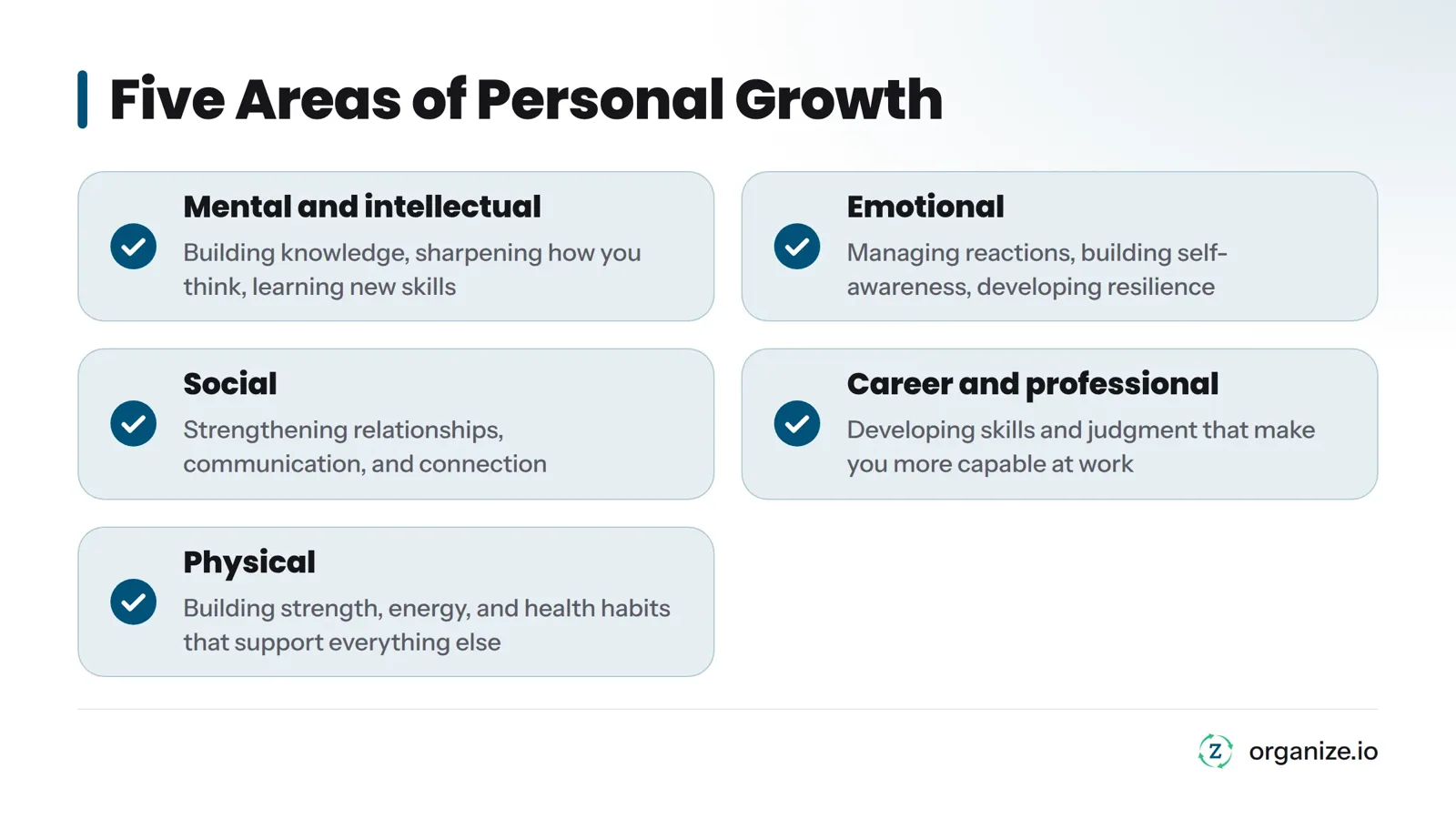
Mental and intellectual growth: Building knowledge, sharpening how you think, learning new skills. A real example looks like reading one genuinely difficult book a month instead of five easy ones, or learning a skill that has nothing to do with your job just to keep your brain flexible.
Emotional growth: Managing your reactions, building self-awareness, developing resilience. It’s the gap between reacting to a hard email in anger and reading it twice before you respond. Self-awareness is the engine here. You can’t manage what you don’t notice.
Social growth: Strengthening relationships, communication, and your ability to connect with people. It shows up in small moments: asking a better question in a conversation, repairing a friendship you let go quiet, learning to disagree without making it personal. It’s not about being more social. It’s about being more effective with the people already in your life.
Career and professional growth: Developing skills and judgment that make you more capable at work. This area gets the most external pressure - performance reviews, promotions, competition - and often the least honest reflection. Real career growth means identifying the one skill gap actually holding you back, not the ten that sound impressive on a resume.
Physical growth: Building strength, energy, and health habits that support everything else. This is the foundation most people skip because it feels separate from “personal” growth. It isn’t. Poor sleep and no movement will quietly cap your mental and emotional growth no matter how many books you read.
Quick self-check: Rate yourself 1 to 5 in each area right now.
Whatever scored lowest is usually not the area you should attack first. It’s often a symptom of a bigger problem.
I built a company from nothing and sold it. Along the way I tried almost every growth hack there is: morning routines, productivity apps, goal-setting templates, books stacked two deep. Most of it didn’t stick. Not because the advice was bad, but because I was adding effort to a life that didn’t have a defined direction yet. I was optimizing a car with no destination.
Here’s the pattern I watched play out in myself and nearly everyone I worked with: you grab a habit (wake up at 5am, journal daily, read 30 minutes) because it sounds like the kind of thing growth-minded people do. It works for eleven days. Then life gets loud and the habit is the first thing to go, because it was never attached to something you actually wanted. It was attached to an idea of self-improvement, floating free of any real reason.
Growth efforts fail almost every time for the same root cause: there’s no defined destination behind them. A habit with no direction is just a task you’ll eventually skip. A habit backed by a clear vision and values is something you’ll protect even on a bad week.
This isn’t a motivational claim. It’s an operational one. Direction changes what a habit means to you, which changes whether you keep doing it when it’s inconvenient.
Before you set a goal or habit, answer three questions. I call this a Compass.
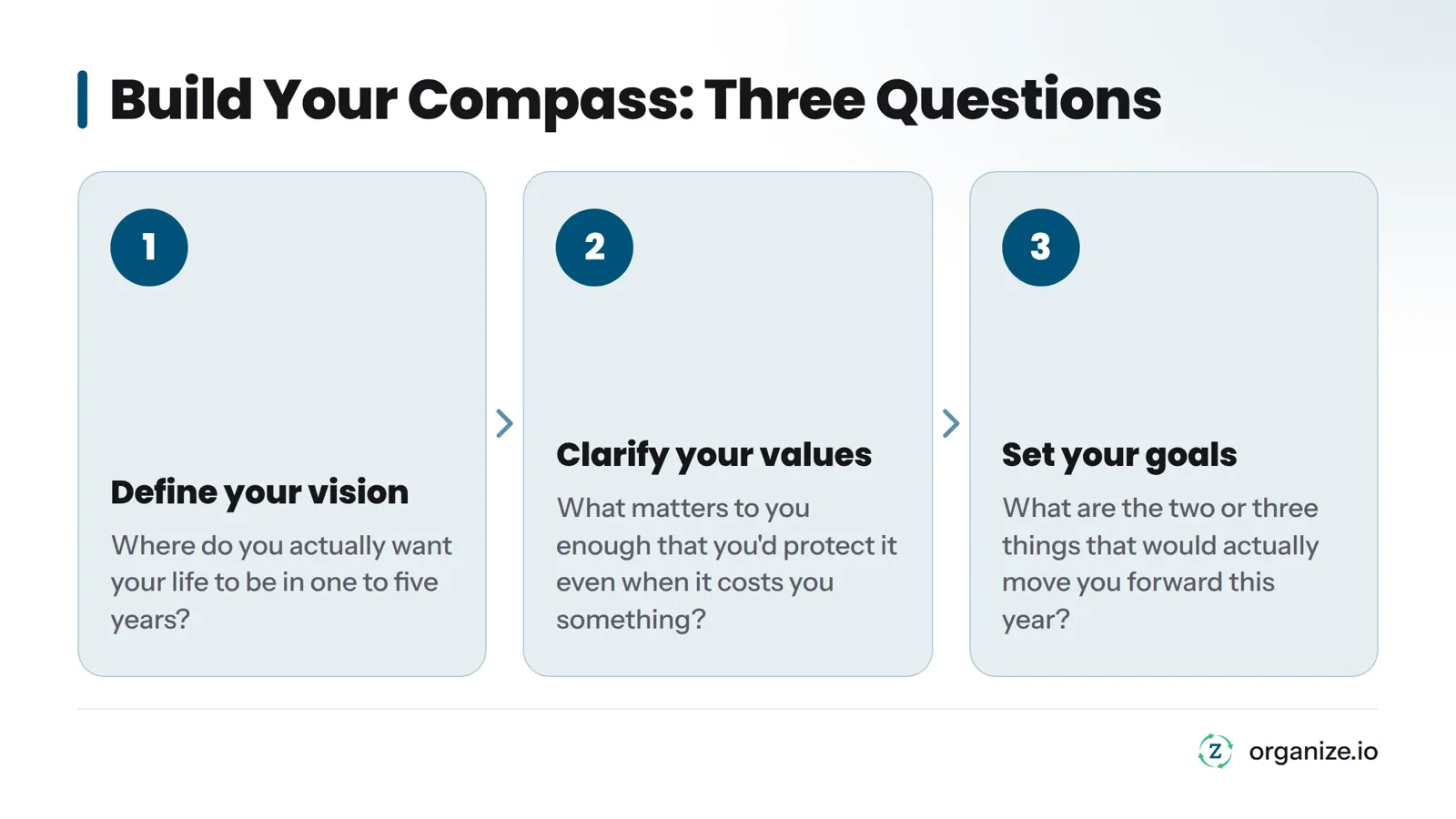
Notice the order. Vision and values come before goals. Goals come before habits. Most self-help content runs this backward, starting with habits and hoping direction shows up eventually. It usually doesn’t, because habits without a destination are just friction with no payoff.
This is the exact sequence built into Zorga’s Compass feature. The app asks you to define vision, values, and goals before it ever asks you to plan a single day. A lot of productivity apps fail because they’re built to help you do more, not to help you decide what’s worth doing in the first place.
These are patterns I see most often when personal growth doesn’t stick. None are character flaws. They’re design problems.
| What goes wrong | Why it happens | The fix |
|---|---|---|
| You start five habits at once | Motivation spikes, but willpower is finite and competing habits cannibalize each other | Pick one habit tied directly to a goal from your Compass, not five random ones |
| You set goals with no reason behind them | The goal came from a list or trend, not your own values | Check every goal against your values before committing to it |
| You quit after missing a few days | All-or-nothing thinking turns a slip into a full stop | Treat a missed day as data, not failure; restart the next day without penalty |
| You keep switching systems or apps | Tool-switching feels like progress but avoids deciding what’s worth doing | Run one system long enough to know whether the problem was the tool or missing direction |
| Growth feels like a chore | The habit isn’t connected to anything you actually care about | Trace the habit back to your vision; if you can’t, drop it |
| You never review progress | Without a regular check-in, small misalignments grow into big ones | Build in a short weekly review - even five minutes - to catch drift early |
A weekly review is a small habit with a large return. Zorga’s Weekly Review feature exists for this: a fixed moment to ask what worked, what didn’t, and whether your goals still match your direction.
Once your direction is set, the rest of personal growth gets straightforward. Vision and values give you a filter. Goals give you a target. Then it’s a matter of building the daily and weekly structure that turns intention into action: a personal development plan with real milestones, a daily action system that connects today’s tasks to your bigger goals, and a habit of reviewing your progress instead of guessing at it.
Zorga’s Daily Action Plan and Dashboard carry that work forward once your Compass is set. The Daily Brief keeps your direction in front of you instead of buried in a notes app you forgot about. For a broader map of where growth applies beyond the five core areas, the 12 areas of life framework is worth exploring once you have direction.
If you want a structured way to walk through all of this without piecing it together from multiple articles, Zorga’s Academy covers the full system from Compass to daily execution, and organize.io lays out how the whole system fits together.
Why do we need personal growth? Because capability, relationships, and health don’t hold steady on their own. Without active effort, skills stagnate, relationships drift into routine, and health slowly erodes. Personal growth is the counterforce: the deliberate choice to keep building instead of standing still.
What personal development goals should I set? Good examples include improving a specific communication skill at work, building a consistent sleep schedule, reading one challenging book a month, repairing a strained relationship, or developing a financial skill you’ve been avoiding. The best goals connect directly to your values, not to a generic list you found online.
How do I work on my personal growth? Start with direction, not habits. Define your vision for the next one to five years, clarify the values you want to live by, then set two or three goals that follow from both. Only after that should you build the daily habits that support those goals.
What’s the difference between personal growth and self-improvement? Personal growth is the broad, lifelong expansion of who you are across mental, emotional, social, career, and physical areas. Self-improvement is usually a specific, shorter-term fix, like improving public speaking or fixing a sleep schedule. Self-improvement can be one ingredient inside personal growth, but it isn’t the whole picture.
What are some examples of personal growth? Reading a genuinely difficult book instead of five easy ones. Noticing a defensive reaction before it comes out of your mouth. Repairing a friendship you let go quiet. Identifying the one career skill actually holding you back and working on it directly. Building a consistent sleep and movement routine. Each lives in one of the five growth areas: mental, emotional, social, career, or physical.
Is personal growth the same as personal development? Not exactly. Personal growth is the outcome and the ongoing process. Personal development is the structured activity, like a plan, a course, or coaching, that supports that growth. Personal development is the method and personal growth is the result.
Personal growth doesn’t fail because people lack willpower. It fails because most advice starts with habits instead of direction. Define your vision, get honest about your values, set a small number of goals that actually follow from both, and the habits that support them will feel a lot less like a chore and a lot more like something worth protecting. Zorga’s Compass and Daily Action Plan are built for exactly that sequence: starting with where you’re headed before asking what you should do today.
Related: how to create a life vision, self-help books worth reading, write your Compass
Goal Setting November 10, 2026
Working harder isn't working. Learn the three hidden failure points—direction, action, feedback—that separate busy effort from real success.
Goal Setting November 7, 2026
Stop reacting to your inbox. Learn the 3-step method to set direction, pick one priority, and protect a focus block that actually moves goals forward.
Goal Setting November 1, 2026
Willpower runs out, but systems don't. Learn the 4-pillar framework behind productivity tips that hold up under real pressure, not just in January.