

Goal Setting November 10, 2026
Productivity and Success: Why Busy Isn't Getting You Ahead
Working harder isn't working. Learn the three hidden failure points—direction, action, feedback—that separate busy effort from real success.
Goal Setting 16 min read
Turn a stalled plan into real progress. Learn the 7-step process to break any proposed plan into clear, assignable action points with deadlines.
You have a plan. Maybe it’s a proposal your boss approved, a business idea you finally wrote down, or a goal you set at the start of the year that’s still sitting there untouched. The plan sounds good on paper. But nothing is happening.
Here’s the real problem: a plan is not a to-do list. A plan is a destination. Action points are the road that gets you there. When you skip breaking your plan into action points, you end up with a document that says what you want but never tells you what to do on Tuesday morning.
To turn a proposed plan into action points, follow this seven-step process:
That’s the whole system. The rest of this guide walks through each step in detail, shows you a worked example from an actual proposed plan, and explains how to keep action points alive instead of watching them die in a forgotten document.
An action point is a single, specific, assignable piece of work that moves a plan forward. It has an owner, a deadline, and a clear finish line. Unlike a goal, it’s not abstract. Unlike a task on a random to-do list, it’s tied directly to a larger plan and has someone’s name attached.
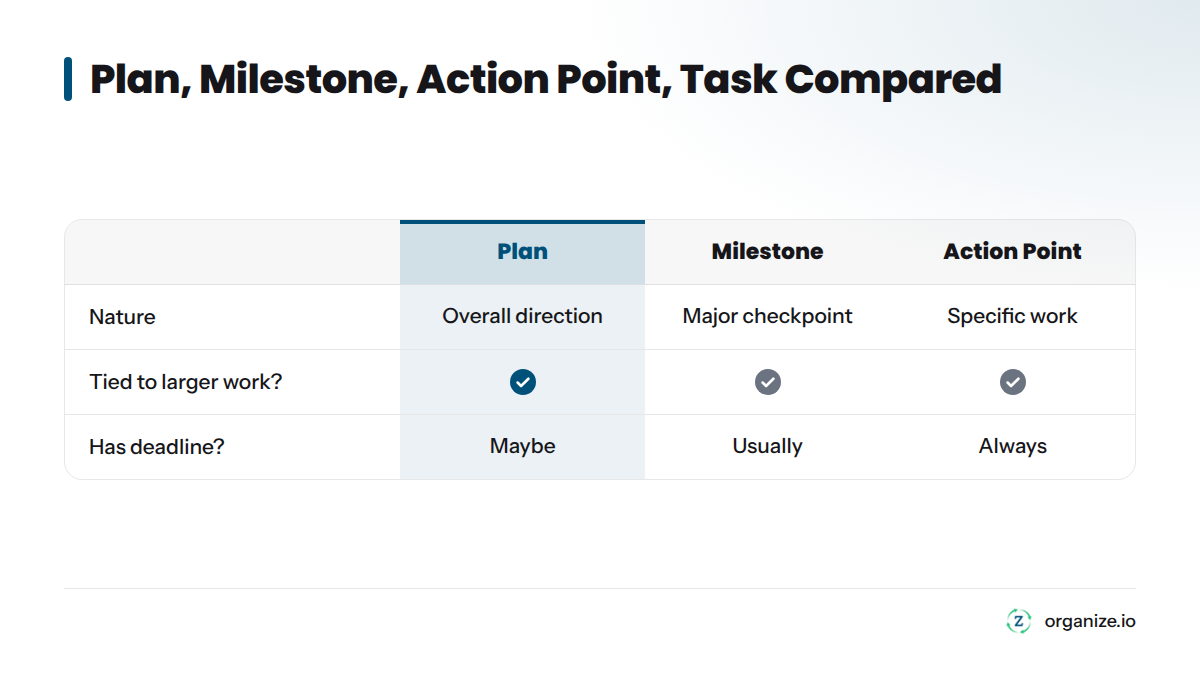
People use “action point,” “task,” “action item,” and “milestone” interchangeably. They don’t mean the same thing. Mixing them up is one of the biggest reasons plans stall before they start.
| Term | Definition | Example |
|---|---|---|
| Plan | The overall direction and outcome you’re working toward | Launch a referral program to grow monthly signups |
| Milestone | A major checkpoint that marks real progress toward the plan | Referral program is live and tracking signups |
| Action point | A specific, ownable piece of work tied to a milestone, with a deadline | Sarah drafts the referral program terms by Friday |
| Task | A smaller, often personal to-do that may or may not connect to a bigger plan | Send Sarah the competitor referral examples |
| Deliverable | The tangible output an action point or milestone produces | A finished, approved referral program terms document |
The distinction that matters: a milestone tells you what “done” looks like at a checkpoint. An action point tells you what specific work gets you there, who does it, and by when. A task is often smaller and less formal than an action point. It might disappear after you complete it. An action point should always survive being written down because it’s tied to something bigger.
This is where the Work Breakdown Structure (WBS), a standard project management method, becomes useful. A WBS breaks a project into smaller and smaller pieces until each one is small enough to assign and estimate. Action points are the bottom layer of that breakdown, the point where planning stops and doing starts.
A plan that stays high-level is a wish. Leadership approves a strategy. Everyone nods. Three months later, nothing visible has changed because the plan never got translated into who does what by when. I’ve watched this happen inside companies I’ve built and inside my own head plenty of times.
When a plan never gets broken into action points, these predictable things happen:
The Community Tool Box, a project of the University of Kansas widely used in public health and community planning, confirms this pattern. A real action plan has to spell out specific action steps, who’s responsible for each, and a timeline for completion, otherwise the plan itself becomes just another document nobody follows.
Work through this method in order, using your own proposed plan as the input.
Before you break anything down, write one sentence stating exactly what success looks like. Not the mission statement version, the concrete version.
Bad: “Improve customer experience.” Good: “Reduce average support response time from 24 hours to 4 hours by the end of Q2.”
If you can’t state the outcome in one specific sentence, you don’t have a plan yet. You have an intention. This is the discipline behind SMART goals (specific, measurable, achievable, relevant, time-bound).
Between where you are now and the final outcome, there are checkpoints. Name them. For most plans, three to six milestones is right. Fewer than three and your milestones are just the final goal restated. More than six and you’re probably listing action points instead of milestones.
This is where the real decomposition happens. For each milestone, ask: “What specific pieces of work have to happen for this milestone to be true?” Write each one as a sentence starting with a verb: draft, call, publish, test, approve, send.
Penn State Extension’s Seven Steps of Action Planning makes a similar point: each action step should be concrete enough that anyone reading it knows exactly what to do without needing further explanation. If someone has to ask “what does this actually mean,” it’s not specific enough yet.
Every action point gets exactly one owner. Not a team, not “marketing,” one person. Shared ownership is how action points quietly die because everyone assumes someone else is on it. This is the logic behind the RACI framework used in project management: someone has to be the single accountable name.
No deadline means no urgency, and no urgency means it competes with everything else on someone’s plate and loses. Every single action point needs a real date, not “soon” or “this quarter.” If you genuinely don’t know when something can happen, that’s a signal the action point is too big and needs to be broken down further.
Not every action point should happen at once. Order them by dependency first (what has to happen before something else can start), then by impact. More on this in the prioritization section below.
Set a recurring time, weekly is ideal, to look at every open action point and ask three questions: is it still relevant, is it still owned, is it still on track. This is the step that separates plans that move from plans that sit. A one-time breakdown is not enough.
Before you consider an action point finished, run it through this checklist:
If an action point fails any of these five checks, it’s not ready. Fix it before moving on.
Let’s make this concrete. A small business owner proposes this plan to their team: “Launch a customer referral program to increase monthly signups by 20% within one quarter.”
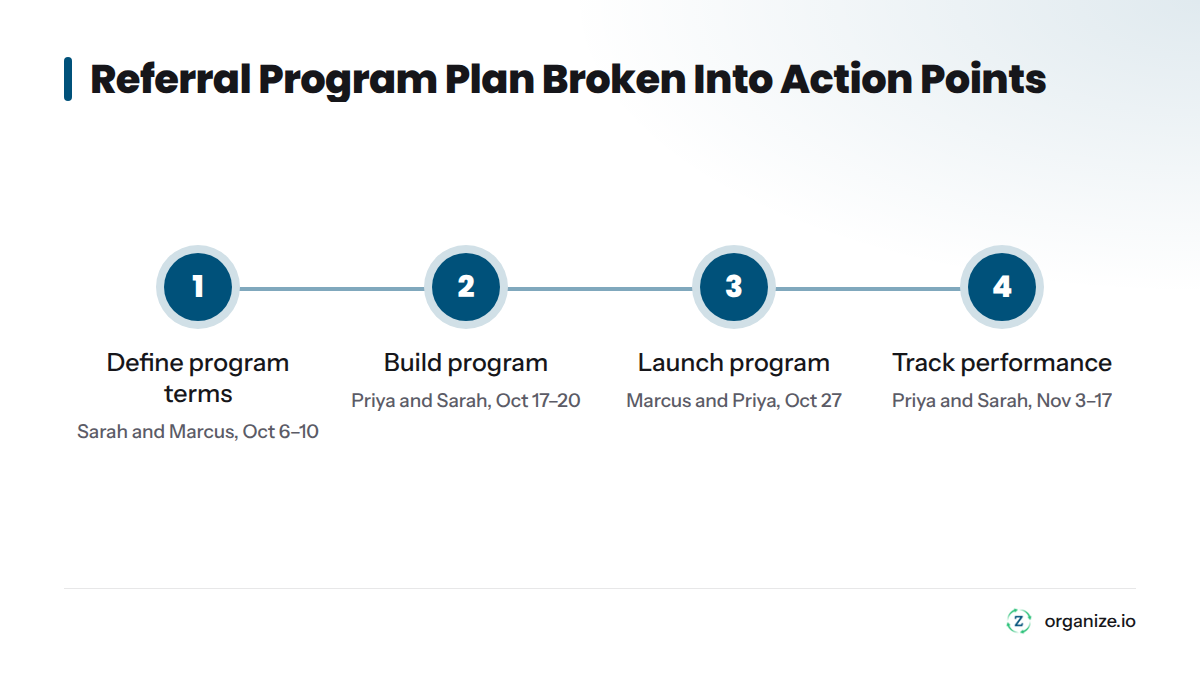
That’s a real plan with a clear outcome. But right now, nobody knows what to do Monday morning. Here’s how it breaks down.
| Milestone | Action Point | Owner | Deadline | Status |
|---|---|---|---|---|
| Program terms defined | Draft referral reward structure (what the referrer and referee each get) | Sarah | Oct 6 | Not started |
| Program terms defined | Get legal sign-off on reward terms | Marcus | Oct 10 | Not started |
| Program is built | Set up referral tracking links in the CRM | Priya | Oct 17 | Not started |
| Program is built | Build the referral landing page | Sarah | Oct 20 | Not started |
| Program launched | Write and send launch email to existing customers | Marcus | Oct 27 | Not started |
| Program launched | Post launch announcement on social channels | Priya | Oct 27 | Not started |
| Program tracked | Set up weekly signup tracking report | Priya | Nov 3 | Not started |
| Program tracked | Review first two weeks of signup data and adjust incentive if needed | Sarah | Nov 17 | Not started |
Notice what happened. The plan itself never changed. What changed is a single sentence became eight specific, ownable, dated pieces of work. Nobody has to wonder what to do next. They just open the list.
Once you have a full list of action points, they will not all matter equally. Trying to do all of them at once is how good plans turn into overwhelming ones.
The simplest method that actually works: sort every action point by impact and effort.
| Low Effort | High Effort | |
|---|---|---|
| High Impact | Do these first | Schedule these deliberately, don’t let them slide |
| Low Impact | Do these when you have spare time | Question whether these belong on the list at all |
High impact, low effort action points go first. They build momentum fast and prove the plan is moving. High impact, high effort items need to be scheduled deliberately because they won’t happen by accident. Low impact, high effort items deserve real scrutiny. Ask if they need to exist at all.
Most action points don’t fail because the plan was bad. They fail because of a handful of repeatable, fixable mistakes.
“Improve onboarding” is not an action point. It’s a goal wearing action point’s clothes. If it can’t be finished in a single sitting or a few clear steps, break it down further until it can.
“The team will handle it” guarantees that nobody handles it. Every action point needs one name attached.
An action point without a deadline has no urgency. An action point that nobody reviews again quietly disappears from memory, even if it’s technically still “on the list.” A weekly review catches both problems before they become invisible.
If your plan has produced 40 open action points and one person, you don’t have a plan, you have a pile. Most people can make genuine progress on three to five action points a week, not thirty.
Here’s what most articles on this topic get wrong: they treat breaking a plan into action points as a single event. Write the list once, done. That’s not how execution actually works. Priorities shift, deadlines slip, new information comes in. An action point list from three weeks ago is already partly out of date.
The fix is simple: review your open action points on a fixed schedule. Every week, ask what got done, what’s overdue and needs a new deadline, and what’s no longer relevant and should get cut.
This is where a system makes all the difference. Most tools let you write a task list, but they don’t connect that list back to why the task exists or force you to look at it again on a schedule. Zorga’s Weekly Review exists specifically to make that check-in automatic. Because action points in Zorga trace back to a Compass, the direction-setting piece of the system, you’re never just checking off busywork disconnected from an actual goal.
If your plan spans a longer stretch of time, tying your milestones to a 90-day planning cycle gives you a natural rhythm for when to reassess the whole list, not just individual action points.
Use this structure for any plan you need to break down. Copy the columns into a spreadsheet, a notebook, or a planning tool.
| Milestone | Action Point | Owner | Deadline | Priority (Impact/Effort) | Status |
|---|---|---|---|---|---|
| [Name the checkpoint] | [Specific, verb-first task] | [One person’s name] | [Real date] | [High/Low Impact, High/Low Effort] | [Not started / In progress / Done] |
Fill in one row per action point. If a row feels too big to finish in a few days, split it into two rows. If you can’t name a single owner for a row, stop and figure out who owns it before moving forward.
What does it mean to break down a proposed plan into action points? It means taking a plan that already exists and converting its stated outcome into specific, assignable, dated pieces of work. The plan tells you the destination. The action points tell you the road.
What is an action point exactly? An action point is a specific, ownable piece of work tied to a larger plan or milestone. It has one owner, one deadline, and a clear definition of done.
How is an action point different from a task? A task can be small, personal, and disconnected from any bigger plan, like “buy printer paper.” An action point is always tied to a milestone within a larger plan and written to move that plan forward.
How is an action point different from a milestone? A milestone is a checkpoint that marks meaningful progress, like “referral program is live.” An action point is one of the specific pieces of work required to reach that checkpoint, like “build the referral landing page.”
What are the steps of an action plan? Restate the goal, identify major milestones, break each milestone into action points, assign an owner to each, set a deadline for each, sequence and prioritize them, and build in a recurring review checkpoint.
How do I propose an action plan? State the outcome clearly, show the major milestones between now and that outcome, and include enough action points under at least the first milestone to prove the plan is realistic. Decision-makers trust plans that show early, concrete steps.
What are the key elements of an action plan? A clear goal, a set of specific action points or steps, assigned ownership for each one, and a timeline with deadlines. Some frameworks add resource or budget as a fifth element.
How many action points should a plan have? It depends on the plan’s size, but a useful rule is three to five active action points per person at any given time. A plan can have dozens of total action points spread across milestones, as long as only a manageable few are active at once.
Who should own each action point? One named person, always. Never a team or a department. If the work genuinely requires multiple people, one person still needs to be the accountable owner who makes sure it happens.
How do you assign deadlines to action points? Work backward from the milestone deadline and the final plan outcome. Sequence dependent action points first, then set realistic dates based on the owner’s actual availability, not just the ideal timeline.
What tools can help break a plan into action points? A basic spreadsheet, a kanban board, or a dedicated planning system all work. What matters more than the tool is whether the action points stay tied to the plan’s goal and get reviewed on a schedule.
How do you prioritize action points when everything feels urgent? Use the impact and effort framework: tackle high-impact, low-effort action points first, schedule the high-impact, high-effort ones deliberately, and question whether low-impact, high-effort items need to exist.
What’s an example of a proposed plan broken into action points? A plan to “launch a referral program to increase signups 20% in one quarter” breaks into milestones like defining terms, building the program, launching it, and tracking results. Each milestone has two to three specific, owned, dated action points underneath.
How often should action points be reviewed? Weekly, at minimum. A weekly review catches overdue items, outdated priorities, and action points that quietly stopped making sense before they become forgotten entirely.
What happens if an action point has no owner? It almost never gets done. Without a named owner, everyone assumes someone else is handling it, and the work falls through.
Why do action points often fail to get done? The most common reasons are vague wording, no single owner, no deadline, and no recurring review. Fix those four things and most stalled plans start moving again.
How do you turn a business proposal into action points? Restate the proposal’s core outcome, identify the milestones a decision-maker would expect to see (like approval, build, launch, and measurement phases), then break each into owned, dated action points.
How do you break down a personal goal into action points? The same method applies. Restate the goal specifically, identify a few milestones between now and the outcome, list the action points under each milestone, assign yourself deadlines, and review your own progress weekly.
What’s the difference between an action plan and a project plan? A project plan typically includes more formal structure: budgets, resource allocation, risk assessments, and often a Gantt chart timeline. An action plan is usually leaner and more direct, focused mainly on what needs to happen, who’s doing it, and by when.
Can an action point be too small or too big? Yes to both. Too big, and it should really be a milestone with its own action points underneath. Too small (like “open the document”), and it’s noise that clutters the list without adding real progress.
How do you track progress on action points over time? Mark each one’s status (not started, in progress, done) and review that status on a fixed schedule. A simple status column in a table is enough for most plans.
What should an action point template include? At minimum: the milestone it belongs to, the specific action, the owner, the deadline, and a status field. Adding a priority or impact/effort rating makes it easier to sequence work when the list gets long.
How do you communicate action points to a team? Share the full breakdown table, not just a summary. People commit more reliably to specific, visible action points with their name next to a date than to a general announcement about a plan.
How is a work breakdown structure related to action points? A Work Breakdown Structure (WBS) is the formal project management method of splitting a project into smaller and smaller components. Action points are essentially the smallest, most actionable layer of that structure, the point where the breakdown becomes something a person can actually go do.
Breaking a plan into action points isn’t a one-afternoon worksheet exercise. It’s a habit. Build the habit once, tie it to a weekly rhythm, and plans stop being documents that sit in a drawer. They start being things that actually happen.
Goal Setting November 10, 2026
Working harder isn't working. Learn the three hidden failure points—direction, action, feedback—that separate busy effort from real success.

Goal Setting November 7, 2026
Stop reacting to your inbox. Learn the 3-step method to set direction, pick one priority, and protect a focus block that actually moves goals forward.
Goal Setting November 1, 2026
Willpower runs out, but systems don't. Learn the 4-pillar framework behind productivity tips that hold up under real pressure, not just in January.