
Goal Setting November 10, 2026
Productivity and Success: Why Busy Isn't Getting You Ahead
Working harder isn't working. Learn the three hidden failure points—direction, action, feedback—that separate busy effort from real success.
Goal Setting 21 min read
Discover the 12 areas of life framework, where it comes from, how it differs from the Wheel of Life, and how to turn a self-assessment into real actions.
Most people searching for “the 12 areas of life” are stuck. Work is fine. Finances aren’t a disaster. But something else is slipping. That gap between “things are okay” and “things feel right” is exactly what this framework is built to find.
Here are the 12 areas of life, by name:
This specific breakdown comes from Lifebook, a life-planning framework created by Jon and Missy Butcher and popularized through Mindvalley, the online learning platform that now hosts the program. It’s one of several ways coaches slice up a life into measurable parts. Other versions use 7, 8, or 20 categories. We’ll get into why the number keeps changing later on.
What nobody selling you a framework tells you is this: naming the 12 areas is the easy part. The hard part is figuring out what to actually do when four or five of them come back low at the same time, and you can’t fix all of them this month. That’s where this guide goes further than most. We’ll define each area in plain language, give you a real way to score yourself, and then walk through exactly how to turn a messy self-assessment into a short list of actions you can run this week.
The 12 areas of life are a set of categories for checking how a person is doing across their whole life, not just at work. Instead of judging your life by one metric - income, job title, Instagram feed - you rate yourself across all 12 and see the full picture at once. The basic idea: you can’t fix what you don’t measure, and most people have only ever measured their bank account and their waistline.
This isn’t a scientific model. It’s a coaching tool. Think of it less like a lab test and more like a dashboard. You glance at it, you see which lights are red, and you decide what to work on first.
The 12-area version most people mean when they search this term traces back to Lifebook, created by husband-and-wife team Jon and Missy Butcher. They built it over roughly three decades of refining their own life-planning process, then structured it into a formal program distributed through Mindvalley. Mindvalley’s guide to the framework lays out all 12 categories in detail, along with the Butchers’ personal take on each one, in Mindvalley: The 12 Areas of Life (and How to Optimize Yours).
This framework is not generic. A lot of pages online present “the 12 areas of life” as if it fell from the sky, with no attribution. It didn’t. It came from a specific program built by specific people. Giving credit where it’s due matters if you want to actually understand where the categories came from and why they’re split the way they are.
The Wheel of Life is an older, more generic coaching tool, usually built around 6 to 8 categories, drawn as a circle divided into pie slices. You rate each slice from the center (low) to the edge (high), then connect the dots. If your life were perfectly balanced, you’d get a smooth circle. Most people get something lumpy. That lumpiness is the point: it shows you where the wheel is flat.
The 12 areas framework uses the same basic logic - rate each category, look for gaps - but splits life into more granular pieces. Where a classic Wheel of Life might lump “Family” and “Friends” into one “Relationships” slice, the 12-area model separates Love Relationships, Parenting, and Social Life into three distinct categories. More categories means more precision. It also means more to track.
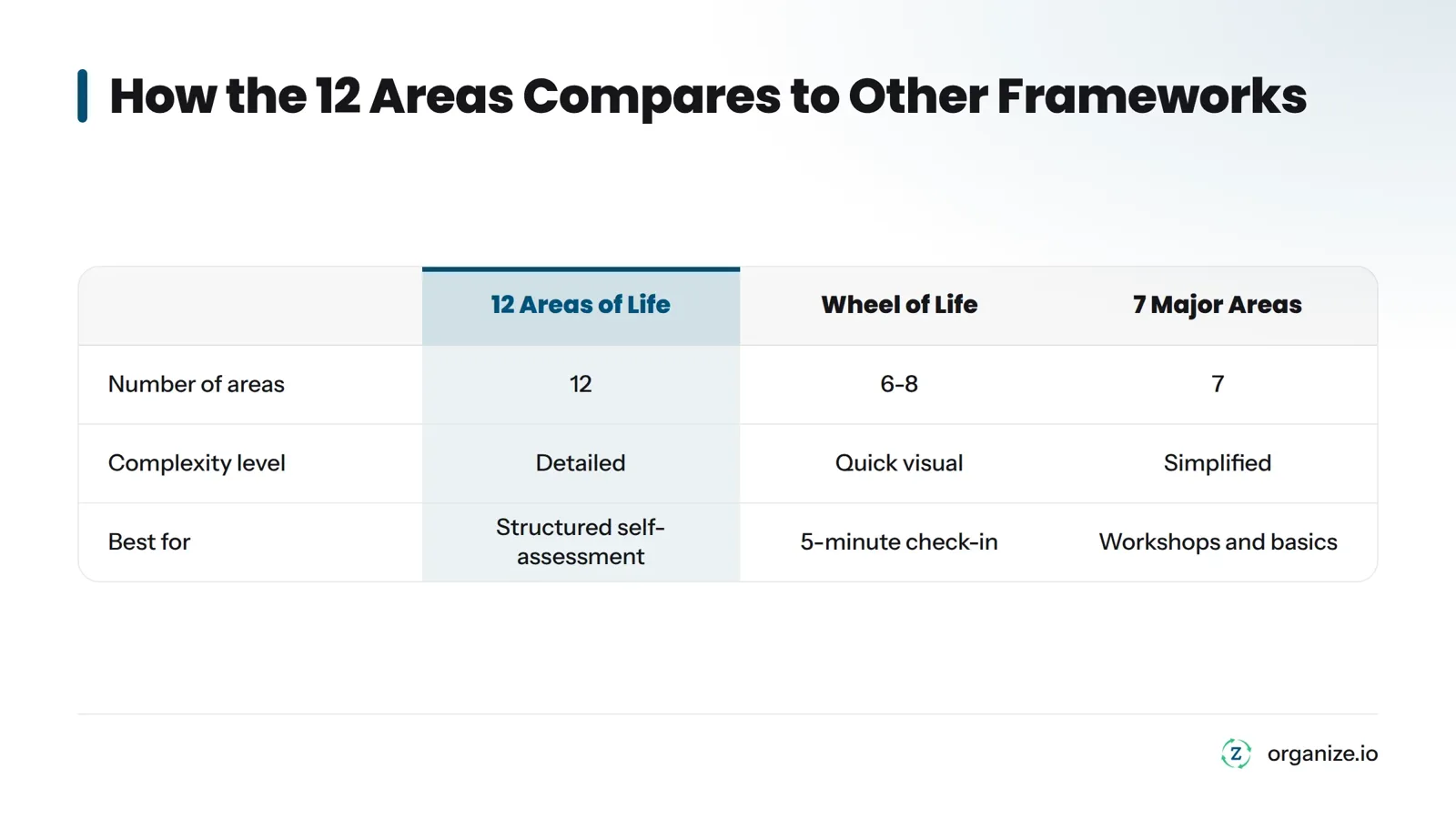
Here’s how the major frameworks compare:
| Framework | Number of Areas | Typical Categories | Best For |
|---|---|---|---|
| 12 Areas of Life (Lifebook) | 12 | Health, Intellectual, Emotional, Character, Spirituality, Love, Parenting, Social, Financial, Career, Quality of Life, Life Vision | People who want a detailed, structured self-assessment and are willing to do more up-front work |
| Wheel of Life | 6-8 | Career, Finances, Health, Family, Relationships, Personal Growth, Fun, Physical Environment | Quick visual check-ins; good for beginners or a 5-minute reset |
| 7 Major Areas of Life | 7 | Career, Financial, Spiritual, Physical, Social, Family, Mental | A simplified version used in workshops and basic worksheets |
| 20 Areas of Life | 20 | Expanded version that splits categories like “Health” into sleep, nutrition, and exercise separately | People who want maximum granularity, often used in intensive coaching |
None of these is “more correct” than the others. They’re different zoom levels on the same idea. The 12-area model is the sweet spot for most people: detailed enough to catch real blind spots, simple enough to finish in one sitting.
If you’re mainly here because you want to turn this into real goals, not just a list, our guide on areas of life for goal setting walks through that process step by step.
Each of these gets a plain definition, one question to ask yourself, and a concrete example of what a low score actually looks like day to day. No fluff.
Your physical body: energy levels, sleep, nutrition, exercise, and how your body actually performs day to day. It’s not about looking a certain way. It’s about whether your body can do what you need it to do without wrecking you.
Ask yourself: Do I have enough energy to get through my day without relying on caffeine, sugar, or sheer will?
What low looks like: You’re tired by 2 p.m. every day, you haven’t exercised in months, and you tell yourself you’ll “start Monday” on repeat.
How much you’re learning, reading, and challenging your thinking. It’s whether your brain is being used or just coasting on autopilot through the same routines.
Ask yourself: When’s the last time I learned something that actually changed how I think or work?
What low looks like: You haven’t finished a book in over a year. Most of your “learning” is scrolling headlines you forget five minutes later.
Your ability to understand and manage your own emotional state: stress, anxiety, anger, joy. It’s not about being happy all the time. It’s about whether you can process what you feel instead of stuffing it down or exploding.
Ask yourself: When something stressful happens, do I handle it, or does it handle me?
What low looks like: Small annoyances turn into bad moods that last all day, and you snap at people over things that aren’t really about them.
The American Psychological Association’s annual Stress in America survey has found that a majority of U.S. adults report their stress affects their physical health, which makes this category less of a “soft” area than people assume. You can see the data for yourself in the American Psychological Association: Stress in America report.
Integrity, discipline, and whether your actions match your values when nobody’s watching. It’s the difference between who you say you are and who you actually are under pressure.
Ask yourself: Do I do what I say I’ll do, even when it’s inconvenient?
What low looks like: You make promises to yourself - workouts, deadlines, boundaries - and consistently break them, then make excuses instead of adjusting.
If this area feels murky, our piece on the importance of values in life breaks down how to actually define your values instead of just vaguely admiring the idea of having them.
Your sense of meaning, purpose, or connection to something bigger than your daily to-do list. For some people that’s religious faith. For others it’s a sense of purpose tied to family, contribution, or legacy. It doesn’t require belief in anything specific.
Ask yourself: Do I feel like my life is pointed toward something that matters to me?
What low looks like: You go through the motions of work and errands without any sense of why, beyond “because I have to.”
Your romantic partnership, whether that’s a spouse, a partner, or your approach to dating if you’re single and want a relationship. It’s about depth, honesty, and connection, not just relationship status.
Ask yourself: Does my romantic relationship (or my approach to finding one) add to my life or drain it?
What low looks like: You and your partner are more like roommates coordinating logistics than people who actually enjoy each other, and neither of you has addressed it.
If you have kids, this covers the quality of your relationship with them and how intentional you are about raising them, as opposed to just managing logistics.
Ask yourself: Am I present with my kids, or just physically in the same room while thinking about something else?
What low looks like: Your interactions with your kids are mostly correction and scheduling, with little unstructured time together.
Your friendships and community outside of romantic and family relationships. It’s about whether you have people you can call, not just people you follow online.
Ask yourself: Do I have at least one or two friends I’ve talked to, really talked to, in the last month?
What low looks like: Your social contact is mostly group chats and social media likes. You can’t remember the last time you made plans with a friend that weren’t tied to a work event.
Income, savings, debt, and your overall relationship with money, including whether you feel in control of it or controlled by it.
Ask yourself: Do I know, right now, roughly how much I have in savings and how much debt I owe?
What low looks like: You avoid checking your bank balance. You’re carrying high-interest debt you’re not actively paying down. Money arguments are a regular source of stress.
Your professional life: whether your work uses your actual skills, pays you fairly, and moves you somewhere you want to go, as opposed to just filling hours.
Ask yourself: If I kept doing exactly what I’m doing for the next five years, would I be glad I did?
What low looks like: You’re competent at your job but bored or resentful. You haven’t had a real conversation about growth or change with yourself in over a year.
Your physical environment and lifestyle: your home, your daily comfort, your recreation, travel, and the small daily details that make life pleasant or grating.
Ask yourself: Does my home environment make my day easier, or does it add friction I’ve just gotten used to?
What low looks like: Your living space is cluttered or disorganized in ways that quietly stress you out every day. You’ve stopped noticing because it’s been that way so long.
The category that ties the other 11 together: do you have a clear, written picture of where you’re headed, or are you just reacting to whatever shows up each day? This is the most overlooked category, and arguably the most important one, because it’s what turns 11 separate scores into one direction.
Ask yourself: If someone asked me to describe my life in five years, could I give a specific answer, or just a vague feeling?
What low looks like: You’re busy and productive by the hour but couldn’t say, with any precision, what you’re actually building toward.
Building an actual answer to that question is the whole point of a tool like Compass, which exists specifically to turn a vague sense of “I should figure out my direction” into a written vision you check against regularly. Our guide on how to create a life vision walks through that process directly.
A quick note before you move on: not every area will feel equally important to you right now. A 25-year-old without kids doesn’t need to stress about a low Parenting score. A retired person may not care much about Career. The framework is a mirror, not a report card. Use the areas that apply to your life and don’t manufacture guilt over the ones that don’t.
Twelve separate scores is a lot to hold in your head at once. Grouping them into clusters makes the picture easier to act on. You start seeing patterns - like “everything in my Self cluster is fine, but my Relationships cluster is a mess” - instead of 12 disconnected numbers.
Here’s a simple four-cluster grouping:
| Cluster | Areas Included | What It Measures |
|---|---|---|
| Self | Health and Fitness, Intellectual Life, Emotional Life, Character | How well you’re taking care of your own mind and body |
| Relationships | Love Relationships, Parenting, Social Life | The quality of your connections to other people |
| Work & Money | Career, Financial Life | Your professional and financial standing |
| Growth & Direction | Spirituality, Quality of Life, Life Vision | Your sense of purpose, environment, and where you’re headed |
Picture a wheel cut into 12 equal slices, arranged in the order above by cluster. Each slice gets shaded in from the center out to however satisfied you are in that area: barely shaded if you’re at a 2, almost fully shaded if you’re at a 9. When you step back and look at the whole wheel, you’re not reading a list of numbers. You’re looking at a shape. A lopsided wheel with four empty slices in the Relationships cluster tells a different story than one with scattered low scores across all four clusters. That story is exactly what points you toward your first move.
This takes about 15 minutes if you’re honest and don’t overthink each score.
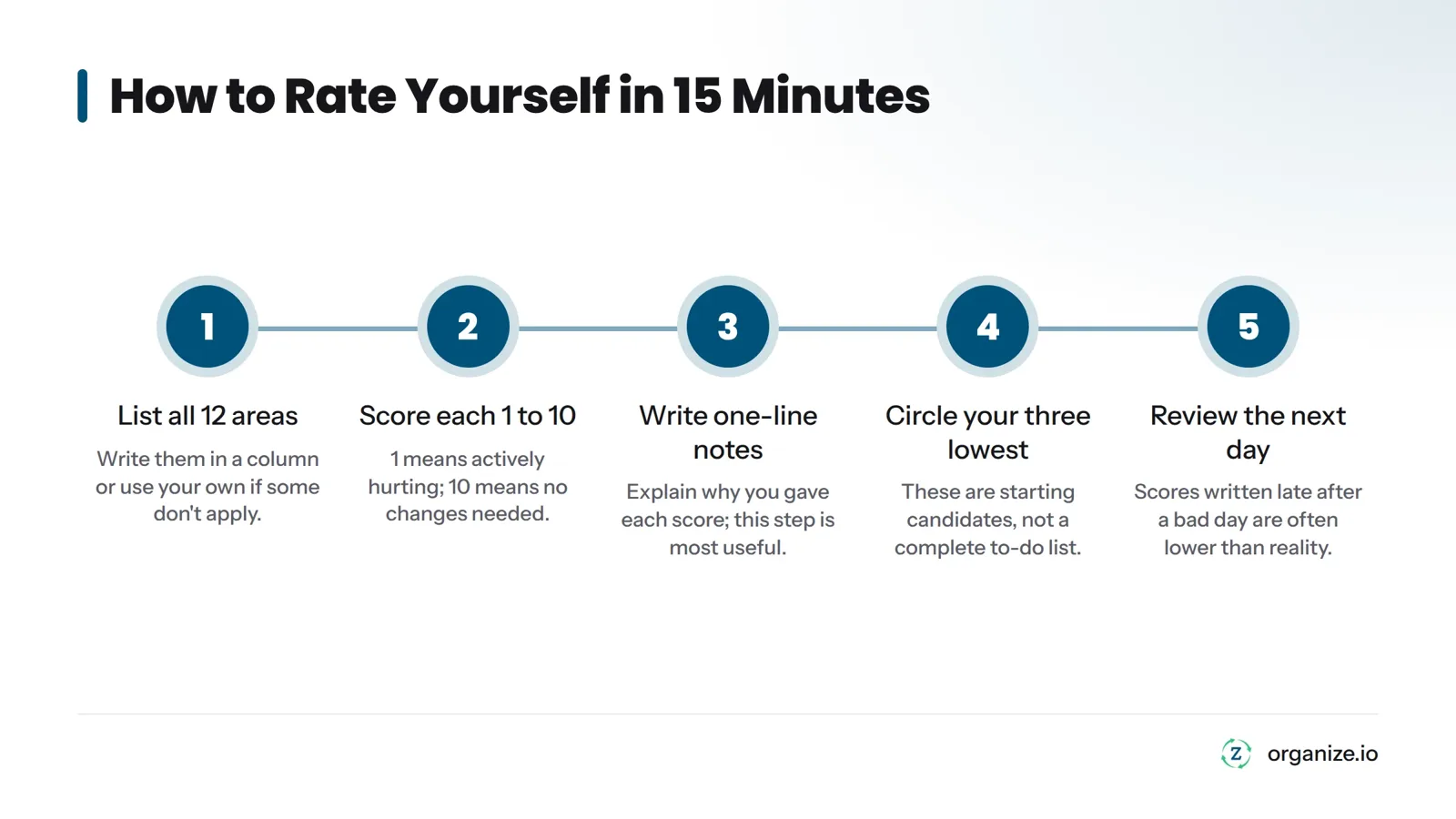
Here’s a simple self-assessment table you can copy into a notes app or print out:
| Area | Score (1-10) | One-Line Note |
|---|---|---|
| Health and Fitness | ||
| Intellectual Life | ||
| Emotional Life | ||
| Character | ||
| Spirituality | ||
| Love Relationships | ||
| Parenting | ||
| Social Life | ||
| Financial Life | ||
| Career | ||
| Quality of Life | ||
| Life Vision |
Quick start (5 minutes):
Keeping this kind of check-in going over time, not just once, is what separates people who actually change something from people who did one assessment and forgot about it. Our life management guide covers how to build that kind of ongoing review into a repeatable habit instead of a one-time exercise.
This is the part every other guide skips, and it’s usually the actual reason someone is reading an article like this at all. If you scored low in two or three areas, you had a tough but doable self-assessment. If you scored low in six or more, you probably feel some mix of overwhelmed and a little ashamed, like you’re behind on your own life.
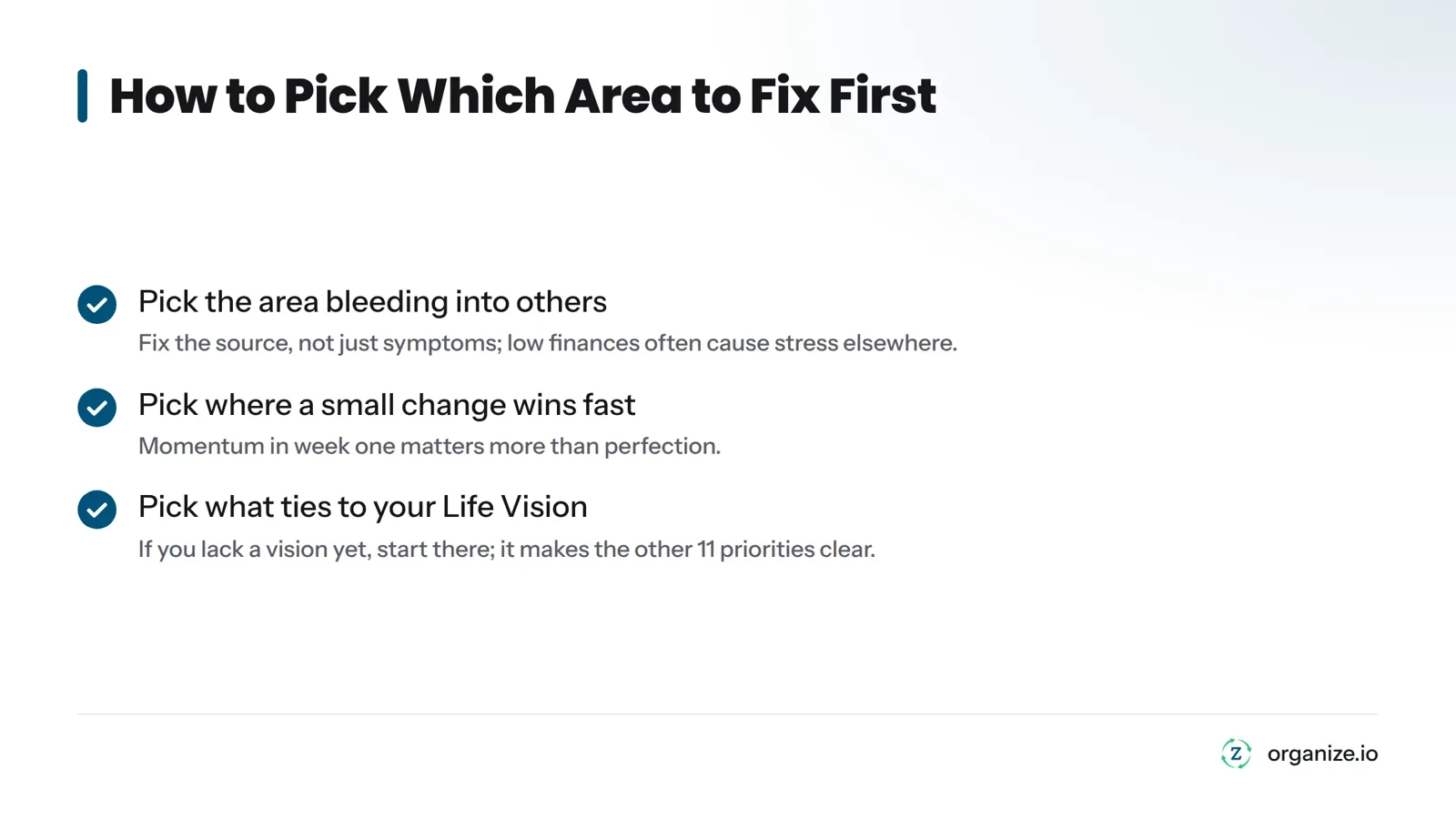
Here’s the truth: you cannot fix 6 areas at once. Nobody can. Trying to overhaul your health, your finances, your relationship, and your career in the same month is how people end up quitting all four within three weeks. It’s not a willpower problem. It’s a math problem. You have a finite amount of time, energy, and attention each week. Splitting it 6 ways guarantees none of the 6 gets enough to actually move.
Pick 1, maybe 2 areas, not more. Use this to choose which one:
Common low-score patterns worth naming:
| Pattern | What’s Usually Going On |
|---|---|
| High Career, low Health | Work is consuming the time and energy that used to go toward the body |
| High Social, low Financial | Spending to keep up with a social circle, or avoiding money conversations that would limit social plans |
| High Character, low Emotional | Discipline is masking unprocessed stress or burnout, not solving it |
| Low Life Vision, scattered scores everywhere else | There’s no clear direction, so effort gets spread thin across everything instead of focused anywhere |
Trying to fix everything at once backfires for a simple reason: it guarantees shallow effort everywhere instead of real progress anywhere. One area, worked consistently for a month, beats six areas worked for three days each.
If a recent life change - a move, a layoff, a breakup, a new baby - is part of why multiple areas tanked at once, our guide on rebuilding your routine after a major life change deals with that exact situation directly.
A self-assessment that sits in a notes app and never gets looked at again isn’t a tool. It’s a journal entry. The real value of the 12 areas of life comes from what you do in the weeks after you score yourself, not the scoring itself.
Here’s the bridge from a score to actual change:
This is exactly the gap that Lifebook, the Wheel of Life, and most worksheets leave open. They stop at the scoring. A real system needs a place to write the vision, a way to break it into weekly actions, and a habit of actually checking in. That’s the structure behind Compass inside Zorga: it’s built to hold your vision and goals for each life area in one place, then feed them into a Weekly Review so you’re actually revisiting your scores instead of letting them go stale. If you want the full picture of how to build a written plan around all of this, our guide on how to create a life plan covers it step by step. The guide on how to set life goals that get results covers the goal-writing part specifically.
Matt Knee, Zorga’s founder, used a version of this kind of structured review while building and eventually exiting a company: a regular, honest look across health, relationships, and work, not just quarterly revenue numbers. The habit that actually worked wasn’t the one-time assessment. It was reviewing it on a set schedule, the same way you’d review a budget, instead of treating it as a one-off exercise you do when things feel bad enough to force the question.
If you’ve tried apps before and they fell apart after week two, that’s usually not a discipline problem. It’s a structure problem. Our piece on why productivity apps fail when you lack direction explains why task lists alone rarely stick without a vision behind them. The Zorga app itself is built around that exact sequence: direction first, then the daily and weekly actions that come from it.
You’ll see different versions of “12 areas of life” depending on which coach or program you’re reading. Some swap “Parenting” for “Family” to cover people without kids. Some merge “Quality of Life” and “Life Vision” into a single “Lifestyle” category and add something else to keep the count at 12. Others rename “Character” as “Personal Development” or split it into “Self” versus “Habits,” which is closer to what you’ll see in worksheets from coaching firms like Handel Group.
None of these variations is wrong. They’re different people organizing the same basic idea: your life has multiple parts, and checking all of them beats checking just one. The number 12 itself isn’t sacred. It’s a useful level of detail, not a rule carved in stone. What actually matters is that you pick a version with categories that map to your real life and stick with the same list long enough to see change over time, rather than switching frameworks every few months looking for the “right” one.
What are the 12 categories of life?
The 12 categories, using the Lifebook framework, are Health and Fitness, Intellectual Life, Emotional Life, Character, Spirituality, Love Relationships, Parenting, Social Life, Financial Life, Career, Quality of Life, and Life Vision.
What are the 12 stages of life in humans?
This is a different concept entirely. The “12 stages of life” typically refers to developmental psychology, covering age-based phases like infancy, early childhood, adolescence, and late adulthood. It has nothing to do with the 12 areas of life framework covered in this guide, which is about categories of your current life, not chronological life stages.
What are 10 areas of life?
There’s no single standard “10 areas of life” list. It usually shows up as a shortened version of either the 12-area or 7-area frameworks, combining a couple of categories to land on a round number. It’s not a distinct, widely recognized model on its own.
What are the 7 major areas of life?
A common 7-area version includes Career, Financial, Spiritual, Physical, Social, Family, and Mental. It’s a simplified version of the 12-area model, often used in church workshops, basic coaching worksheets, or quick self-help content where more detail isn’t needed.
What is the Wheel of Life and how is it different from the 12 areas of life?
The Wheel of Life is a visual coaching tool, usually built on 6 to 8 categories, drawn as a pie chart you rate from the center outward. It’s the older, more generic version of this same idea. The 12 areas of life framework (specifically the Lifebook version) uses more categories for a more detailed picture. The core method - rating each slice of your life and looking for the gaps - is the same.
Where can I get a 12 areas of life PDF or printable worksheet?
You can build your own in under 10 minutes using the self-assessment table in this guide: list the 12 areas, score each 1-10, add a one-line note, and circle your lowest three. Several coaching organizations also offer downloadable worksheets. Most, like the one-page PDF from Handel Group, give you only the category labels without explanation or guidance on what to do with your scores.
What are the 20 areas of life?
The 20-area version is an expanded breakdown used mostly in intensive coaching or therapy settings, where broader categories from the 12-area model get split further. “Health” might become separate entries for sleep, nutrition, and exercise, for example. It offers more precision at the cost of taking longer to complete.
How often should I reassess the 12 areas of life?
Reassess fully every 90 days, with a lighter check-in weekly on just the one or two areas you’re actively working on. A full 12-area reassessment monthly is usually overkill. Life doesn’t shift that fast, and reassessing too often can feel like busywork instead of real reflection.
Can I combine or skip some of the 12 areas?
Yes. If Parenting doesn’t apply to you, skip it. If you want to combine Quality of Life and Life Vision because they feel related in your situation, that’s fine too. The framework is a tool for clarity, not a fixed test you have to complete exactly as written.
Is the 12 areas of life framework the same as Lifebook?
The 12-category version most commonly referenced is specifically the Lifebook framework, created by Jon and Missy Butcher and distributed through Mindvalley. Other coaches have since adapted similar 12-category lists with slightly different labels, but the original, specific version traces back to Lifebook.
For a broader look at how to use any of these frameworks for setting actual goals rather than just scoring yourself, our best goals in life guide and the goal tracking software roundup are both worth a look if you’re ready to move from assessment into action.
A self-assessment isn’t a verdict on your life. It’s a snapshot, taken on one day, that tells you where to look next. The real work starts after you close the notebook: picking one area, writing down what better looks like, and checking back in on a schedule instead of letting it fade into another thing you meant to do. That’s the difference between a framework you did once and a system you actually run.
Goal Setting November 10, 2026
Working harder isn't working. Learn the three hidden failure points—direction, action, feedback—that separate busy effort from real success.

Goal Setting November 7, 2026
Stop reacting to your inbox. Learn the 3-step method to set direction, pick one priority, and protect a focus block that actually moves goals forward.
Goal Setting November 1, 2026
Willpower runs out, but systems don't. Learn the 4-pillar framework behind productivity tips that hold up under real pressure, not just in January.